
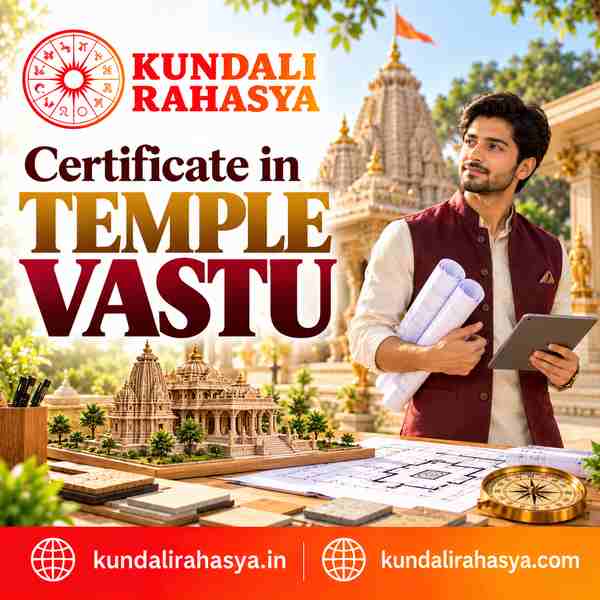
Description
Course Name: Certificate in Temple Vastu
Temple Vastu is the systematic study of traditional Vastu Shastra principles and their practical application to temples, shrines, prayer halls, religious institutions, and sacred architectural spaces. It focuses on directional analysis, temple entrance positioning, sanctum placement, mandapa arrangements, deity installation areas, ritual spaces, traditional corrective approaches, and the structured assessment of temple architecture and layouts.
The Certificate in Temple Vastu provides learners with a structured understanding of traditional Temple Vastu principles, temple property inspection, directional mapping, floor-plan analysis, identification of common Vastu concerns, traditional remedies, practical case studies, consultation techniques, and professional ethics.
Course Details
- Course Name: Certificate in Temple Vastu
- Course Code: KR/CTV/160
- Course Level: Professional Certificate
- Eligibility: 10th Pass or Equivalent
- Duration: 3 Months
- Learning Mode: Online / Self-Paced / Recorded Lectures
- Examination Mode: Online MCQ Examination
- Certificate Validity: Lifetime
- Certificate Verification: Online Verification Facility
About the Certificate in Temple Vastu Course
The Certificate in Temple Vastu provides foundational knowledge of traditional Vastu principles with an emphasis on their practical application to temples and sacred spaces. It is designed for learners who wish to understand temple orientation, directional significance, entrance positioning, sanctum arrangements, mandapa layouts, prayer halls, ritual areas, supporting facilities, and traditional methods of temple property assessment.
Learners study temple inspection, directional mapping, identification of common Vastu concerns, traditional corrective approaches, and practical case studies. Exercises help learners document temple property observations, evaluate architectural layouts, consider suitable traditional recommendations, and prepare basic Temple Vastu assessment reports. The course addresses traditional Vastu interpretation and does not replace structural engineering, heritage conservation, fire safety, accessibility, or applicable religious and building regulations.
Course Objective
The objective of this Certificate is to develop a foundational understanding of Temple Vastu and introduce practical skills in temple property assessment, directional mapping, floor-plan analysis, sanctum and mandapa placement assessment, identification of common Vastu concerns, traditional remedies, consultation documentation, and professional communication.
Learners will study:
Fundamentals of Temple Vastu
Traditional Vastu principles and terminology
Directions and directional significance
Panchamahabhuta and the five elements
Vastu Purusha Mandala
Temple orientation and sacred property assessment
Temple inspection and assessment fundamentals
Main entrance positioning and temple layouts
Directional mapping and floor-plan analysis
Sanctum and deity installation area considerations
Mandapa and prayer hall arrangements
Ritual spaces and circumambulatory pathways
Supporting facilities and administrative areas
Identification of common Temple Vastu concerns
Traditional Vastu remedy concepts
Non-demolition corrective approaches
Practical temple assessment case studies
Consultation methods and report preparation
Professional ethics and responsible communication
Admission, Learning, Examination & Certification Process
Step 1 – Select Your Course: Choose the Certificate in Temple Vastu from the course catalogue after reviewing the course details and eligibility requirements.
Step 2 – Complete Online Enrollment: Submit the required information through the online enrollment process.
Step 3 – Make Secure Payment: Pay the applicable course and examination fee through the available payment options.
Step 4 – Receive Learning Access: Receive study access and login details at the registered email address after enrollment processing.
Step 5 – Study Online: Access recorded lectures and study materials. Complete directional mapping activities, temple layout reviews, sacred property assessment exercises, and practical case studies.
Step 6 – Appear for the Online Examination: Complete the online MCQ examination after finishing the required learning.
Step 7 – Receive Your Certificate: Successful candidates receive their digital certificate by registered email and the original certificate according to the applicable dispatch process.
Step 8 – Online Certificate Verification: Verify the authenticity of the issued certificate through the online verification facility.
Step 9 – Career Guidance & Job Assistance: Eligible certified candidates may receive career guidance and information about suitable professional opportunities. Job assistance does not guarantee employment.
Who Should Enroll in the Certificate in Temple Vastu?
This course may be suitable for Vastu Enthusiasts, Beginners, Aspiring Vastu Consultants, Existing Vastu Practitioners, Temple Administrators, Religious Institution Managers, Temple Trustees, Temple Property Owners, Sacred Architecture Enthusiasts, Heritage Property Professionals, Property Consultants, Interior Designers, Architectural Planning Professionals, Real Estate Professionals, Freelance Consultants, and Working Professionals interested in the traditional application of Vastu principles to temples and sacred spaces.
Core Learning Areas
Foundations of Temple Vastu
Study traditional Vastu concepts, directional significance, Panchamahabhuta, and Vastu Purusha Mandala as foundations for sacred property assessment.
Temple Inspection and Assessment
Learn introductory methods for reviewing temple orientation, entrances, sanctum arrangements, mandapas, prayer halls, ritual areas, and spatial organization within traditional Vastu frameworks.
Directional Mapping and Floor-Plan Analysis
Develop skills in identifying principal directions, reading temple floor plans, examining sacred architectural layouts, and documenting important property features.
Temple Layout and Sacred Space Planning
Explore traditional considerations for positioning sanctums, mandapas, prayer halls, ritual spaces, circumambulatory pathways, entrances, and supporting facilities.
Traditional Corrective Approaches
Study commonly discussed Temple Vastu remedies and non-demolition approaches while considering religious practices, architectural requirements, practical limitations, and responsible communication.
Consultation & Professional Ethics
Learn to document observations, organize recommendations, communicate responsibly, respect religious traditions, maintain confidentiality, and prepare basic Temple Vastu assessment reports.
Certificate in Temple Vastu Syllabus
Module 1: Foundations of Temple Vastu
Study traditional Vastu foundations, terminology, directional significance, Panchamahabhuta, and Vastu Purusha Mandala. Understand their role in evaluating temple layouts and sacred environments.
Module 2: Temple Inspection and Directional Mapping
Explore introductory temple inspection methods, sacred property orientation, principal directions, entrance positioning, and directional mapping. Practise recording observations using basic temple floor plans.
Module 3: Sanctum Placement and Mandapa Assessment
Study traditional considerations relating to sanctum arrangements, deity installation areas, mandapas, prayer halls, and visitor circulation. Practise identifying and documenting common temple layout concerns.
Module 4: Sacred Layout and Floor-Plan Analysis
Learn introductory methods for reviewing temple entrances, sanctum areas, mandapas, ritual spaces, circumambulatory pathways, and supporting facilities within traditional Vastu frameworks. Explore assessment considerations for different temple layouts and sizes.
Module 5: Traditional Temple Vastu Remedies and Practical Applications
Explore traditional corrective approaches, including spatial adjustments and commonly discussed non-demolition remedies. Practise considering possible recommendations in relation to temple layouts, religious practices, architectural requirements, and practical limitations.
Module 6: Practical Case Studies & Professional Ethics
Apply course concepts through temple assessment case studies, directional mapping exercises, and floor-plan reviews. Practise consultation planning, basic report preparation, respectful communication, confidentiality, and responsible presentation of traditional recommendations.
Temple Vastu Assessment Framework
Property Inspection
Review temple orientation, entrances, sanctum arrangements, mandapas, prayer halls, ritual areas, circumambulatory pathways, and spatial organization using traditional Vastu principles.
Directional Mapping
Identify principal directions and apply directional references to temple entrances, sanctum areas, mandapas, prayer halls, ritual spaces, and floor plans.
Layout Assessment
Examine sanctum positions, mandapa arrangements, prayer areas, ritual spaces, and supporting facilities to document features relevant to traditional Temple Vastu interpretation.
Floor-Plan Analysis
Practise reviewing temple floor plans, visitor circulation paths, sacred architectural arrangements, and functional areas while recording potential Vastu concerns in a structured format.
Traditional Remedy Assessment
Consider traditional corrective approaches in relation to identified concerns, temple layouts, religious customs, heritage considerations, and practical limitations. Any proposed alterations should respect applicable religious, conservation, and safety requirements.
Practical Case Documentation
Prepare records containing temple details, directional charts, layout observations, traditional interpretations, and proposed recommendations.
Report Preparation
Organize findings into clear Temple Vastu assessment reports that explain observations, traditional approaches, and relevant limitations.
Certification Process
After successfully completing the online examination requirements, candidates receive a digital certificate by registered email and an original certificate according to the applicable dispatch process. Issued certificates can be verified through the online certificate verification facility. Certificate validity is lifetime.
Career Opportunities
After completing the Certificate in Temple Vastu, learners may explore entry-level opportunities depending on their knowledge, practical competence, further learning, and client demand.
Potential areas include Temple Vastu Consultation Assistant, Junior Vastu Assessment Assistant, Sacred Property Assessment Support, Temple Layout Assessment Assistant, Sanctum Layout Assessment Support, Mandapa and Prayer Hall Assessment Assistant, Religious Institution Vastu Assessment Support, Heritage Property Documentation Assistant, Temple Floor-Plan Assessment Assistant, Property Inspection and Documentation Support, Vastu Research and Documentation Assistant, Freelance Temple Vastu Practitioner, Traditional Knowledge Content Creator, and Workshop Assistant.
The course does not guarantee employment, clients, or income. Traditional Vastu interpretations should not be presented as guaranteed solutions to financial, structural, personal, or institutional concerns. Structural safety, heritage conservation, fire safety, accessibility, and regulatory compliance should be assessed by appropriately qualified professionals. Religious customs and temple-specific requirements should be respected when considering any recommendations.
Scope for Independent Temple Vastu Practice
Practitioners may gradually develop services involving:
Basic Temple Vastu Consultation
Temple Vastu Assessment
Shrine Vastu Assessment
Prayer Hall Vastu Assessment
Religious Institution Vastu Assessment
Temple Entrance Direction Analysis
Sanctum Placement Assessment
Mandapa Layout Assessment
Prayer Hall Layout Assessment
Ritual Area Assessment
Circumambulatory Pathway Assessment
Supporting Facility Assessment
Sacred Property Inspection and Documentation
Directional Mapping
Temple Layout Evaluation
Temple Floor-Plan Analysis
Identification of Common Temple Vastu Concerns
Traditional Temple Vastu Remedy Guidance
Non-Demolition Remedy Guidance
Basic Temple Vastu Assessment Reports
Online Temple Vastu Consultation
Educational Articles and Workshops
Practical Temple Assessment Case Study Documentation
Expected Income & Earning Potential
Earning potential varies according to expertise, experience, specialization, client volume, consultation fees, professional reputation, and work arrangement.
Indicative ranges:
- Beginner / Entry-Level: ₹2,50,000–₹5,00,000 per year
- Experienced Consultant: ₹5,00,000–₹10,00,000 per year
- Independent Practitioner: ₹7,00,000–₹15,00,000+ per year
- Established Professional: ₹12,00,000–₹20,00,000+ per year
These figures are illustrative estimates only and are not guaranteed earnings. Actual income depends on individual circumstances and market demand.
Why Choose a Certificate in Temple Vastu?
The Certificate in Temple Vastu focuses on applying traditional Vastu principles to temples, shrines, prayer halls, and religious institutions. It introduces learners to directional mapping, temple inspection, sanctum placement, mandapa arrangements, ritual spaces, floor-plan analysis, and traditional corrective approaches through a structured, practice-oriented learning program.
The program progresses from foundational concepts to sacred property assessment exercises, practical case studies, consultation documentation, and professional ethics. Its online, self-paced learning format allows learners to study according to their schedules and establish a foundation for further learning in Temple Vastu.
What is a Certificate in Temple Vastu?
It is a professional certificate-level course introducing the application of traditional Vastu principles to temple assessment, directional mapping, sanctum placement, sacred layout analysis, traditional remedies, and consultation documentation.
Can I learn Temple Vastu online?
Yes. The course provides online learning through recorded lectures and study materials.
What practical skills will I develop?
Learners practise temple inspection, directional mapping, floor-plan analysis, sanctum and mandapa assessment, identification of common Vastu concerns, consideration of traditional remedies, case documentation, and basic assessment report preparation.
What is the eligibility?
The minimum eligibility is 10th Pass or Equivalent.
Is the examination conducted online?
Yes. The assessment is conducted through an online MCQ examination.
Can I become a Temple Vastu Consultant after completing this course?
The course develops foundational knowledge of Temple Vastu assessment. Professional consultation also requires continued learning, practical experience, responsible communication, respect for religious traditions, and an understanding of professional boundaries.
Is the certificate verifiable online?
Yes. Issued certificates can be checked through the online certificate verification facility.
Who can join this course?
Beginners, Vastu enthusiasts, aspiring consultants, existing practitioners, temple administrators, religious institution managers, property consultants, architectural planning professionals, and sacred architecture enthusiasts may enroll, subject to the stated eligibility requirements.
