
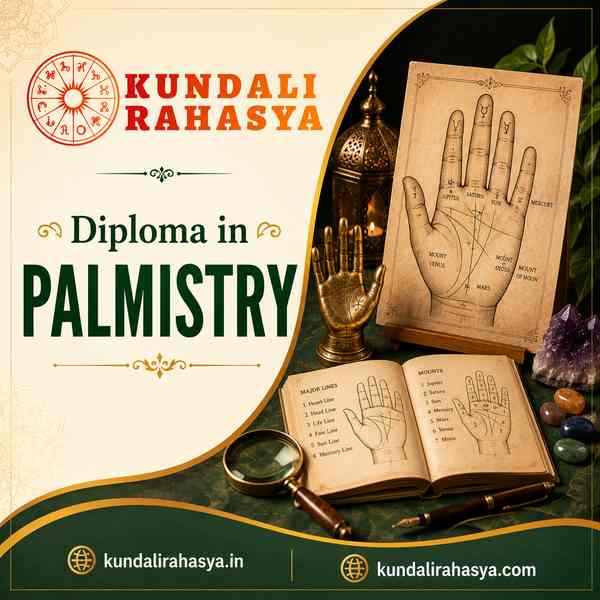
Description
Diploma in Palmistry
Palmistry is a traditional interpretive practice that studies the shape of the hands, fingers, mounts, lines, markings, and other features of the palm for symbolic interpretation. The Diploma in Palmistry provides a structured introduction to palm-reading principles, hand classification, finger characteristics, mounts, major and minor lines, palm markings, hand shapes, comparative analysis, and practical palmistry interpretation.
The course is designed to help learners understand the fundamental principles of palmistry and develop a systematic approach to observing and interpreting different features of the hand. It combines theoretical learning with practical exercises so that students can progressively develop skills in hand observation, line identification, mount analysis, marking interpretation, and preparation of structured palmistry readings.
Course Details
Course Name: Diploma in Palmistry
Course Code: KR/D/PAL76
Course Type: Professional Diploma
Eligibility: 10th Pass or Equivalent
Duration: 6 Months
Learning Mode: Online / Self-Paced / Recorded Lectures
Assessment: Online MCQ Examination
Certificate Validity: Lifetime
Certificate Verification: Online Verification Available
About the Diploma in Palmistry
The Diploma in Palmistry is designed for learners who want to systematically study the traditional principles and practical application of palmistry.
The program begins with the fundamentals of hand observation and gradually progresses toward the study of hand shapes, fingers, mounts, major lines, minor lines, signs, markings, and overall palm interpretation.
Students learn how different physical features of the hand are traditionally interpreted and how multiple palm features can be considered together when preparing a structured reading.
The course also introduces practical palm-reading techniques, enabling learners to identify important features of the hand and develop a systematic approach to traditional palmistry analysis.
Course Objective
The main objectives of the Diploma in Palmistry are to:
- Develop a strong understanding of fundamental palmistry concepts.
- Understand different hand shapes and classifications.
- Study the structure and characteristics of fingers and thumbs.
- Understand the major mounts of the palm.
- Identify and interpret major palm lines.
- Introduce minor lines and significant palm markings.
- Understand traditional interpretations of signs and symbols.
- Learn comparative observation of both hands.
- Develop a systematic approach to palm analysis.
- Apply learned concepts through practical hand-reading exercises.
- Develop the ability to prepare structured palmistry observations.
Admission Process
Step 1: Select the Course
Choose the Diploma in Palmistry program and review the course details, eligibility, duration, and learning structure.
Step 2: Complete Enrolment
Fill in the online admission/enrolment form with the required candidate details.
Step 3: Submit Required Information
Provide the required personal and educational information for enrolment processing.
Step 4: Pay the Course Fee
Complete the applicable course-fee payment through the available online payment options.
Step 5: Receive Login Details
After successful enrolment and payment confirmation, access/login details are provided for the online learning platform.
Step 6: Start Learning
Access recorded lectures, study materials, and other available learning resources.
Step 7: Complete the Course
Study the modules and complete the prescribed learning activities and preparation.
Step 8: Appear for Online Assessment
Complete the online MCQ examination/assessment after fulfilling the course requirements.
Step 9: Certificate
After successful completion of the assessment requirements, the course completion certificate is processed and made available according to the certification procedure.
Who Should Enroll?
The Diploma in Palmistry can be suitable for:
- Beginners interested in learning palmistry.
- Palmistry enthusiasts and learners.
- Aspiring palmistry consultants.
- Students interested in traditional knowledge systems.
- Astrology learners and practitioners.
- Numerology and related traditional-practice learners.
- Spiritual and holistic practitioners.
- Individuals interested in hand analysis.
- Professionals looking to develop an additional skill.
- Freelancers and aspiring independent practitioners.
- Researchers and students of traditional palmistry.
- Content creators interested in palmistry.
- Anyone seeking structured online learning in palmistry.
Core Learning Areas
1. Palmistry Fundamentals
Introduction to palmistry, history and development, basic terminology, hand observation, palm structure, and fundamental principles of traditional palm reading.
2. Hand Shapes, Fingers and Thumb
Classification of hands, palm shapes, finger characteristics, finger proportions, thumb structure, flexibility, length, and traditional interpretations.
3. Mounts and Major Lines
Study of the major palm mounts and the Life Line, Head Line, Heart Line, Fate Line, Sun Line, and other important lines.
4. Minor Lines and Palm Markings
Understanding minor lines, special markings, signs, symbols, islands, crosses, stars, squares, triangles, branches, breaks, and other traditional palm features.
5. Comparative and Advanced Palm Analysis
Comparison of both hands, active and passive hand concepts, line variations, mount development, combinations of signs, and integrated palm interpretation.
6. Practical Palmistry Reading
Applying palmistry principles through systematic hand observation, line identification, mount analysis, marking interpretation, comparative assessment, and preparation of practical readings.
Diploma in Palmistry – Detailed Syllabus
Module 1: Fundamentals of Palmistry
Introduction to Palmistry, History and Development of Palm Reading, Basic Palmistry Terminology, Structure of the Hand, Palm and Fingers, Hand Observation Techniques, Basic Hand Classification, Palm Texture and Flexibility, Skin Patterns and General Features, Fundamentals of Palm Interpretation
Module 2: Hand Shapes, Fingers and Thumb
Classification of Hand Shapes, Earth Type Hand, Air Type Hand, Fire Type Hand, Water Type Hand, Finger Length and Proportion, Finger Shape and Structure, Fingernail Characteristics, Thumb Structure and Flexibility, Traditional Interpretation of Fingers and Thumb
Module 3: Mounts and Major Palm Lines
Mount of Jupiter, Mount of Saturn, Mount of Apollo or Sun, Mount of Mercury, Mount of Venus, Mount of Moon, Mount of Mars, Life Line, Head Line and Heart Line, Fate Line and Sun Line, Traditional Interpretation of Major Lines and Mounts
Module 4: Minor Lines and Palm Markings
Minor Palm Lines, Marriage or Relationship Lines, Health or Mercury Line, Intuition Line, Travel Lines, Bracelet or Rascette Lines, Islands and Breaks, Crosses and Stars, Squares and Triangles, Branches and Other Significant Palm Markings
Module 5: Comparative and Advanced Palm Analysis
Analysis of Both Hands, Active and Passive Hand Concepts, Dominant and Non-Dominant Hand, Line Variations, Line Depth and Clarity, Mount Development, Multiple Marking Combinations, Relationship Between Lines and Mounts, Integrated Palm Observation, Advanced Traditional Interpretation
Module 6: Practical Palmistry Reading
Palm Examination Methodology, Client Information and Hand Observation, Hand Shape Assessment, Finger and Thumb Analysis, Mount Assessment, Major Line Analysis, Minor Line and Marking Analysis, Comparative Hand Analysis, Preparation of Palmistry Reports, Practical Palm-Reading Case Studies
Assessment Framework
The assessment framework is designed to evaluate the learner’s understanding of fundamental and practical palmistry concepts.
Learners may be assessed on:
- Palmistry terminology and fundamental principles.
- Hand shapes and classification.
- Finger and thumb characteristics.
- Palm structure and texture.
- Major palm mounts.
- Major palm lines.
- Minor palm lines.
- Traditional palm markings and symbols.
- Line variations and combinations.
- Comparative analysis of both hands.
- Practical hand-observation exercises.
- Structured palmistry interpretation.
Practical Learning
Practical exercises may include:
- Identifying different hand shapes.
- Observing palm texture and flexibility.
- Identifying finger types and proportions.
- Analysing the thumb.
- Locating and identifying major mounts.
- Identifying the Life Line.
- Identifying the Head Line.
- Identifying the Heart Line.
- Identifying the Fate and Sun Lines.
- Identifying minor lines and markings.
- Comparing both hands.
- Preparing a structured palmistry reading.
Certification
After successful completion of the prescribed course and assessment requirements, learners receive the Diploma in Palmistry course completion certificate.
The certificate can include relevant candidate and course details and may be supported by an online verification facility as per the applicable certification process.
Career Opportunities
After completing the Diploma in Palmistry, learners may explore opportunities such as:
- Palmistry Consultant
- Palm Reader
- Online Palmistry Consultant
- Palmistry Practitioner
- Palmistry Content Creator
- Palmistry Research Assistant
- Palmistry Course Trainer
- Traditional Knowledge Content Professional
- Freelance Palmistry Practitioner
- Astrology and Palmistry Service Professional
The actual scope of professional practice depends on the learner’s knowledge, practical experience, specialization, applicable local requirements, and professional development.
Scope for Independent Practice
Learners who develop sufficient practical knowledge may explore independent palmistry-related activities such as:
- Online palm-reading consultations.
- Personal palmistry readings.
- Palm analysis reports.
- Offline palm-reading sessions.
- Palmistry workshops.
- Educational palmistry sessions.
- Palmistry content creation.
- Astrology and palmistry learning services.
- Social-media palmistry education.
- Freelance palmistry services.
Independent practice should be conducted responsibly, with clear communication about the traditional and interpretive nature of palmistry and without presenting palmistry interpretations as medical, legal, financial, or other professional guarantees.
Expected Income
Income from palmistry-related activities can vary considerably depending on knowledge, experience, specialization, consultation model, location, reputation, audience, and business development.
Indicative earning ranges sometimes used for planning purposes may include:
- Beginner / Entry-Level: ₹2,50,000–₹5,00,000 per year
- Experienced Consultant: ₹5,00,000–₹10,00,000 per year
- Independent Practitioner: ₹7,00,000–₹15,00,000+ per year
- Established Professional: ₹12,00,000–₹20,00,000+ per year
Note: These figures are indicative only and are not a guarantee of income. Actual earnings may be lower or higher depending on individual circumstances and professional activity.
Why Choose an Online Diploma in Palmistry?
- Learn from home at your own convenience.
- Self-paced learning structure.
- Access recorded learning content.
- Suitable for beginners.
- No requirement for regular classroom attendance.
- Learn alongside professional or personal commitments.
- Study palmistry concepts in a structured sequence.
- Revise learning materials according to individual pace.
- Develop knowledge for personal learning or future professional exploration.
- Online assessment and certification process.
Frequently Asked Questions
What is a Diploma in Palmistry?
The Diploma in Palmistry is a structured learning program covering hand shapes, fingers, thumb, palm mounts, major and minor lines, palm markings, comparative hand analysis, and practical palm-reading techniques.
What is the eligibility for the Diploma in Palmistry?
The general eligibility for this course is 10th Pass or Equivalent.
What is the duration of the course?
The duration of the Diploma in Palmistry is 6 months.
Is the course available online?
Yes. The course is designed for online, self-paced learning with recorded lectures.
Is prior knowledge of palmistry required?
No. The course begins with fundamental palmistry concepts and progressively introduces practical palm-reading techniques.
What will I learn in this course?
You will learn hand classification, fingers and thumb, palm mounts, major lines, minor lines, palm markings, comparative hand analysis, and practical palmistry interpretation.
Is there an examination?
Yes. The course includes an online MCQ-based assessment/examination as part of the completion process.
Is the certificate valid for a lifetime?
The course certificate is intended to have lifetime validity as a course-completion credential.
Can I start palmistry consultation after completing the course?
The course provides foundational and practical learning in palmistry. Learners may explore independent practice after developing adequate knowledge and practical experience, subject to applicable requirements and responsible professional conduct.
Can I study the course while working?
Yes. The online and self-paced learning format can allow learners to study according to their available time.
Can beginners enroll?
Yes. The program is suitable for beginners who want to develop structured knowledge of palmistry.
Enquiry / Admission
For admission, course information, fee details, or enrolment assistance, candidates can submit an enquiry through the available course enquiry form.
