
Description
Course Name: Advanced Certificate in Scientific Palmistry
Scientific thinking encourages careful observation, consistent documentation, and the evaluation of claims through evidence. The Advanced Certificate in Scientific Palmistry introduces learners to the structured study of palm features while distinguishing observable hand characteristics from traditional palmistry interpretations and claims that require scientific evidence.
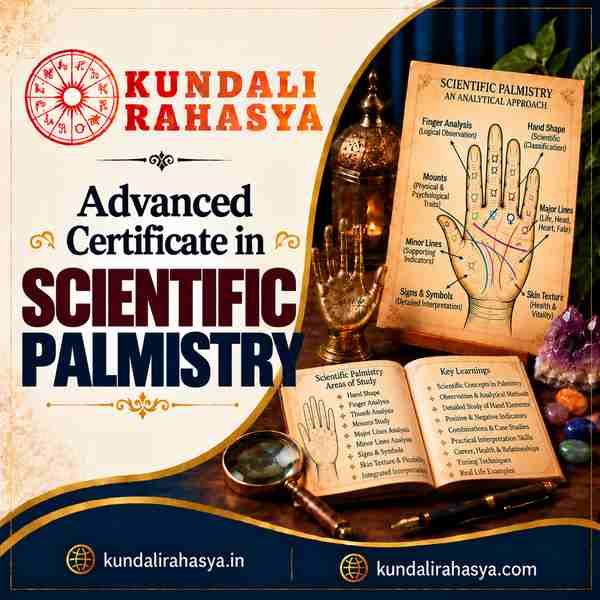
The course explores hand shapes, finger proportions, thumb characteristics, palm lines, mounts, visible markings, and variations in hand structure. Learners practise describing these features, comparing observations, recording findings systematically, and examining how traditional interpretations differ from evidence-based conclusions.
An important part of the programme is critical evaluation. Palmistry has not been scientifically established as a reliable method for predicting life events or determining personality. Accordingly, the course uses scientific observation and critical-thinking principles to examine palmistry concepts without presenting traditional interpretations as proven scientific findings.
Course Details
- Course Name: Advanced Certificate in Scientific Palmistry
- Course Code: KR/ACP/SP2570
- Course Level: Professional Certificate
- Eligibility: 10th Pass or Equivalent
- Duration: 3 Months
- Learning Mode: Online / Self-Paced / Recorded Lectures
- Examination Mode: Online MCQ Examination
- Certificate Validity: Lifetime
- Certificate Verification: Online Verification Facility
About the Advanced Certificate in Scientific Palmistry Course
This course introduces learners to systematic observation of the human hand and the critical examination of concepts associated with palmistry. It covers visible hand characteristics, including shapes, fingers, thumbs, palm lines, mounts, and markings, while encouraging learners to distinguish measurable features from subjective descriptions and symbolic interpretations.
The programme combines introductory hand analysis, observation exercises, comparative documentation, critical evaluation, and responsible communication. Learners develop the ability to describe what they observe, recognise the limitations of interpretations, and assess claims without confusing traditional beliefs with established scientific evidence.
Course Objective
The objective is to develop structured observation skills and critical understanding of palmistry while encouraging evidence-aware thinking, accurate documentation, and responsible interpretation.
Learners will study:
- Introduction to palmistry and its traditional background.
- Principles of systematic observation and description.
- Basic terminology used in hand analysis.
- Identification of commonly discussed hand shapes.
- Observation of finger proportions and visible characteristics.
- Description of thumb structure and movement.
- Identification and documentation of major palm lines.
- Introduction to minor lines and visible variations.
- Observation of palm mounts and surface markings.
- Comparison of visible hand characteristics across samples.
- Distinction between measurable observations and subjective interpretations.
- Introduction to scientific reasoning and evidence evaluation.
- Recognition of unsupported claims and overgeneralisation.
- Methods for recording observations consistently.
- Basic comparison of observations across different examples.
- Understanding variability in human hand characteristics.
- Critical examination of traditional palmistry interpretations.
- Ethical communication, privacy, and informed consent.
- Limitations of palmistry as a predictive or personality-assessment method.
Admission, Learning, Examination & Certification Process
Step 1 – Select Your Course: Review the course details, eligibility, syllabus, learning outcomes, and programme duration before enrolling.
Step 2 – Complete Online Enrollment: Submit the required registration information through the designated enrollment process.
Step 3 – Make Secure Payment: Complete the applicable course payment using the available payment facility and retain the confirmation.
Step 4 – Receive Learning Access: Follow the provided instructions to access the available lessons and study materials after enrollment processing.
Step 5 – Study Online: Complete recorded lectures, review course concepts, and practise structured observation using suitable learning examples.
Step 6 – Appear for the Online Examination: Attempt the online MCQ examination according to the organisation’s examination instructions.
Step 7 – Receive Your Certificate: Learners who fulfil the applicable completion and assessment requirements may receive their certificate under the organisation’s certification procedures.
Step 8 – Online Certificate Verification: Use the available verification facility to check the details of an issued certificate.
Step 9 – Career Guidance & Job Assistance: Guidance may help learners explore relevant educational or professional directions but does not guarantee employment or income.
Who Should Enroll in the Advanced Certificate in Scientific Palmistry Course?
This programme may suit palmistry learners, students interested in human hand characteristics, traditional metaphysics enthusiasts, educators preparing introductory learning materials, and individuals who want to examine palmistry through structured observation and critical thinking.
Learners should be willing to document visible features, compare examples carefully, evaluate claims, and distinguish traditional beliefs from evidence-based conclusions. No prior professional experience is specified as a requirement.
Core Learning Areas
Foundations of Palmistry
Explore the history, terminology, and traditional frameworks associated with palmistry.
Hand Structure and Observation
Study visible hand shapes, finger proportions, thumb characteristics, and differences between individual hands.
Palm Lines and Markings
Identify commonly discussed major and minor lines, mounts, surface markings, and visible variations.
Scientific Observation Methods
Learn to describe observable characteristics clearly, use consistent terminology, and avoid unsupported assumptions.
Critical Thinking and Evidence Evaluation
Examine the difference between traditional interpretations, personal opinions, testable claims, and scientifically supported conclusions.
Comparative Documentation
Practise recording observations in a consistent format and comparing sample hands without exaggerating differences.
Interpretation and Limitations
Review traditional palmistry interpretations while recognising the limitations of using palm features to infer personality or predict life events.
Ethics and Responsible Communication
Understand consent, privacy, respectful language, transparent communication, and the importance of avoiding misleading claims.
Advanced Certificate in Scientific Palmistry Syllabus
Module 1: Introduction to Palmistry and Scientific Thinking
Traditional background, foundational terminology, introduction to hand observation, critical thinking, and the difference between historical beliefs and scientific evidence.
Module 2: Hand Shape, Fingers and Thumb Observation
Identification and description of commonly discussed hand shapes, finger proportions, thumb structure, and visible characteristics, with emphasis on consistent observation.
Module 3: Palm Lines, Mounts and Markings
Identification of major and minor palm lines, mounts, surface markings, and variations. Introduction to descriptive recording without assuming that visible features establish future outcomes.
Module 4: Observation, Comparison and Documentation
Structured observation methods, sample-based exercises, consistent recording formats, comparison of visible characteristics, and recognition of individual variation.
Module 5: Critical Evaluation of Palmistry Claims
Introduction to evidence evaluation, testable claims, alternative explanations, subjective interpretation, overgeneralisation, and the distinction between correlation and causation.
Module 6: Ethics, Communication and Responsible Practice
Confidentiality, informed consent, responsible communication, transparent presentation of limitations, and avoiding unsupported medical, psychological, financial, or predictive claims.
Scientific Palmistry Assessment Framework
Requirement Review
Understand the objectives of each observation exercise and identify the relevant sample material and recording requirements.
Visual Observation
Describe visible hand characteristics, including shape, proportions, lines, mounts, and markings, using clear and consistent terminology.
Hand Shape Recognition
Identify commonly discussed hand shapes and describe their observable characteristics without treating traditional classifications as scientific personality categories.
Finger and Thumb Observation
Record finger proportions, thumb structure, and visible characteristics while avoiding conclusions that exceed the available evidence.
Major Line Recognition
Identify commonly discussed major palm lines and describe their visible position, direction, and appearance.
Minor Line and Mount Observation
Recognise commonly discussed minor lines and mounts and document their visible features without assuming predictive significance.
Marking and Variation Review
Describe visible markings and variations carefully, distinguishing direct observation from interpretation or assumption.
Observation Record Quality
Maintain organised records with clear descriptions, consistent terminology, and an explicit distinction between observations and conclusions.
Comparative Observation
Compare sample hands systematically, account for individual variation, and avoid drawing broad conclusions from limited examples.
Critical Interpretation Review
Evaluate traditional palmistry claims by considering evidence quality, alternative explanations, testability, and the limitations of the available observations.
Communication and Ethics
Demonstrate respectful communication, privacy awareness, informed consent, and transparency about the limitations of palmistry.
Final Evaluation
Complete the online MCQ examination and meet the applicable assessment and course-completion requirements.
Certification Process
Learners who complete the required learning activities and fulfil the applicable assessment criteria may receive the Advanced Certificate in Scientific Palmistry according to the organisation’s certification procedures. The stated certificate validity is lifetime, with online verification available through the designated facility where provided. Certification confirms course completion and should not be represented as scientific accreditation or proof that palmistry predictions are scientifically validated.
Career Opportunities
The course can support further learning in palmistry, structured observation, educational content development, and introductory workshop preparation. Learners may use their knowledge to explain traditional palmistry concepts while clearly communicating the distinction between observable hand characteristics and unverified interpretations.
Possible activities include preparing educational materials, supporting introductory workshops, documenting hand-analysis examples, or pursuing further study in critical thinking and human hand variation.
Career outcomes depend on individual skills, experience, demand, and applicable requirements. The certificate does not guarantee employment, professional recognition, clients, or income.
Scope for Independent Scientific Palmistry Practice
Learners may explore educational and observation-based activities such as:
- Explaining the traditional background of palmistry.
- Introducing commonly used palmistry terminology.
- Describing observable hand shapes and proportions.
- Recording visible finger and thumb characteristics.
- Identifying commonly discussed major palm lines.
- Documenting minor lines and visible variations.
- Describing palm mounts and surface markings.
- Preparing structured hand-observation worksheets.
- Comparing visible features across sample hands.
- Maintaining consistent observation records.
- Developing educational presentations about palmistry traditions.
- Explaining the difference between observation and interpretation.
- Reviewing claims through critical-thinking exercises.
- Conducting introductory educational sessions.
- Communicating the limitations of palmistry responsibly.
Independent activities should respect privacy, obtain consent, and avoid presenting palmistry as a scientifically proven method for diagnosing health conditions, assessing psychological states, determining compatibility, or predicting life events. Medical, psychological, legal, and financial concerns should be referred to appropriately qualified professionals.
Expected Income & Earning Potential
Income depends on the nature of the work, experience, demand, and operating costs. The following figures are illustrative estimates rather than verified salary benchmarks or guaranteed outcomes.
Indicative ranges:
- Beginner / Entry-Level: ₹1,80,000 – ₹4,00,000 per year
- Experienced Practitioner: ₹4,00,000 – ₹8,00,000 per year
- Independent Practitioner: ₹6,00,000 – ₹12,00,000+ per year
- Established Professional: ₹9,00,000 – ₹16,00,000+ per year
Actual earnings may be lower or higher, and course completion does not guarantee employment, clients, or income.
Why Choose an Online Advanced Certificate in Scientific Palmistry
The online, self-paced format allows learners to revisit recorded lessons, review key concepts, and complete observation exercises according to their schedules.
The curriculum combines traditional palmistry concepts with systematic documentation, critical evaluation, comparative observation, and responsible communication, helping learners approach the subject with greater clarity and awareness of its limitations.
What is an Advanced Certificate in Scientific Palmistry?
It is a professional certificate programme covering palmistry concepts, hand observation, palm lines, mounts, markings, documentation, critical thinking, and evidence-aware interpretation.
Is palmistry scientifically proven?
No. Palmistry has not been established as a reliable scientific method for predicting life events or determining personality. This course examines traditional concepts while emphasising critical evaluation and responsible communication.
Can I study this course online?
Yes. The stated learning mode is online, self-paced study with recorded lectures, subject to the organisation’s course arrangements.
What is the eligibility for this course?
The stated eligibility is 10th Pass or Equivalent. Learners should also complete the applicable registration requirements.
Is prior palmistry knowledge required?
Prior professional experience is not specified as a requirement. Learners should be prepared to study foundational terminology and practise structured observation.
What will I learn in this programme?
You will study hand shapes, fingers, thumb characteristics, palm lines, mounts, visible markings, observation methods, documentation, critical evaluation, and ethical communication.
Is the examination conducted online?
Yes. The stated examination mode is an online MCQ examination. Learners must follow the applicable examination instructions.
Will this certificate qualify me to diagnose medical conditions?
No. This programme is not medical training and does not qualify learners to diagnose or treat medical conditions. Health concerns should be addressed by qualified healthcare professionals.
Can I start an independent practice after completing the course?
You may explore relevant educational or interpretive activities within your competence and applicable requirements. The certificate does not guarantee clients, employment, or income, and palmistry should not be presented as scientifically proven prediction.
Is the certificate verifiable online?
An online certificate verification facility is listed in the course details. Issued certificate information may be checked through the organisation’s designated verification process.
