
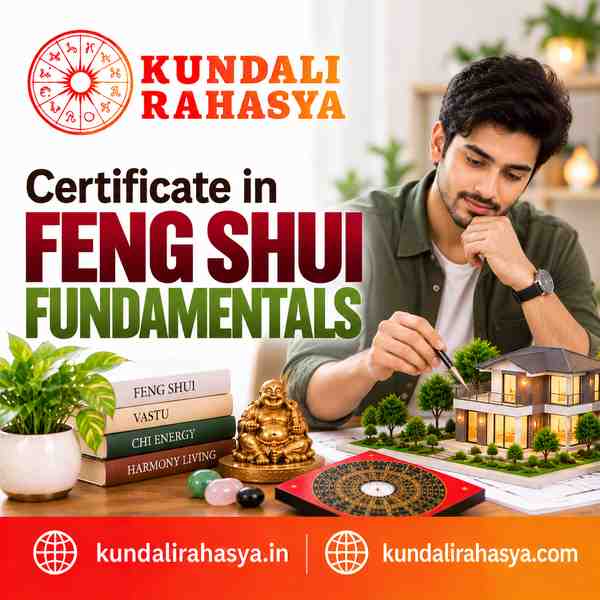
Description
Course Name: Certificate in Feng Shui Fundamentals
Feng Shui Fundamentals introduces the traditional study of spatial harmony through directions, environmental features, Yin-Yang principles, Five Elements, Bagua, orientation, entrances, rooms, and spatial relationships. Certificate in Feng Shui Fundamentals provides structured learning in foundational Feng Shui concepts, elemental associations, directional understanding, environmental observation, basic property assessment, practical examples, recommendation planning, consultation, reporting, and professional ethics.
The program establishes a foundation for understanding traditional Feng Shui terminology and spatial assessment. Learners examine orientation, directions, Five Elements, Bagua frameworks, entrances, room functions, circulation, furniture placement, environmental characteristics, and basic case documentation.
Practical learning emphasizes observation, documentation, traditional perspectives, and responsible communication without presenting Feng Shui interpretations as guaranteed outcomes.
Course Details
- Course Name: Certificate in Feng Shui Fundamentals
- Course Code: KR/C/FF1945
- Course Level: Professional Certificate
- Eligibility: 10th Pass or Equivalent
- Duration: 3 Months
- Learning Mode: Online / Self-Paced / Recorded Lectures
- Examination Mode: Online MCQ Examination
- Certificate Validity: Lifetime
- Certificate Verification: Online Verification Facility
About the Certificate in Feng Shui Fundamentals Course
The Certificate in Feng Shui Fundamentals provides foundational professional-oriented study of traditional Feng Shui principles and their relationship with built environments.
Learners examine terminology, Yin-Yang principles, Five Elements, directions, Bagua, orientation, environmental forms, entrances, rooms, circulation, furniture placement, and basic spatial relationships.
Learning also introduces simple assessment methods, case documentation, recommendation planning, client communication, report preparation, confidentiality, professional boundaries, and responsible consultation practice.
Course Objective
The objective of this Certificate is to develop foundational knowledge of Feng Shui while strengthening practical skills in spatial observation, directional understanding, Five Element assessment, Bagua application, environmental observation, entrance analysis, room evaluation, basic spatial assessment, recommendation planning, consultation, report preparation, and professional ethics.
Learners will study:
Feng Shui foundations
Feng Shui terminology
Yin-Yang principles
Five Elements
Directions and orientation
Bagua frameworks
Compass-based observations
Environmental features
Property observation
Entrances and access areas
Room assessment
Furniture placement
Circulation and functional zones
Spatial relationships
Elemental associations
Basic Feng Shui case studies
Recommendation planning
Consultation and reporting
Professional ethics
Admission, Learning, Examination & Certification Process
Step 1 – Select Your Course: Choose the Certificate in Feng Shui Fundamentals from the course catalogue.
Step 2 – Complete Online Enrollment: Submit the required information through the online enrollment process.
Step 3 – Make Secure Payment: Pay the applicable course and examination fee through available payment options.
Step 4 – Receive Learning Access: Study access and login details will be provided to the registered email address after enrollment processing.
Step 5 – Study Online: Access study materials and recorded learning resources throughout the prescribed three-month course duration.
Step 6 – Appear for the Online Examination: Complete the online MCQ examination after finishing the required learning.
Step 7 – Receive Your Certificate: Candidates who successfully complete the examination process receive the applicable certificate. The digital certificate is sent to the registered email address, while the original certificate is dispatched according to the applicable process.
Step 8 – Online Certificate Verification: The authenticity of the issued certificate can be checked through the online verification facility.
Step 9 – Career Guidance & Job Assistance: Eligible certified candidates may receive career guidance and information about suitable opportunities. Job assistance does not constitute a guarantee of employment.
Who Should Enroll in the Certificate in Feng Shui Fundamentals Course?
This Online Certificate may be suitable for beginners, Feng Shui learners, aspiring spatial consultants, interior designers, architects, property professionals, real-estate consultants, business owners, Vastu practitioners, and working professionals interested in learning traditional Feng Shui.
No previous professional qualification in Feng Shui is required. The program begins with fundamental concepts before introducing spatial observation, basic property assessment, practical examples, recommendation planning, consultation, and reporting.
Core Learning Areas
Feng Shui Foundations
Study Feng Shui terminology, traditional background, Yin-Yang principles, Five Elements, directional concepts, and foundational approaches to understanding spaces.
Directions, Orientation & Bagua
Explore directions, property orientation, Bagua frameworks, compass observations, spatial sectors, and methods for organizing basic assessment information.
Five Elements & Spatial Associations
Examine elemental qualities, associations, interactions, materials, shapes, and traditional relationships across different spatial environments.
Environmental Features & Property Observation
Study surrounding buildings, roads, terrain, neighboring properties, building forms, entrances, and relevant external environmental characteristics.
Entrance, Circulation & Movement
Develop methods for observing entrances, access paths, circulation routes, transitions, movement patterns, and connections between functional areas.
Rooms, Furniture & Functional Areas
Learn approaches to rooms, furniture placement, work areas, living areas, activity zones, storage, service spaces, and basic functional relationships.
Basic Spatial Assessment & Case Analysis
Apply structured observation to floor plans, spatial functions, layouts, elemental relationships, simple cases, and recommendation planning.
Consultation, Reporting & Ethics
Develop basic client consultation, assessment records, recommendation reports, follow-up procedures, confidentiality, professional boundaries, and ethical communication.
Certificate in Feng Shui Fundamentals Syllabus
Module 1: Introduction to Feng Shui Fundamentals
Study Feng Shui terminology, traditional background, Yin-Yang principles, Five Elements, directions, spatial objectives, and foundational concepts for understanding built environments.
Module 2: Directions, Bagua, Elements & Orientation
Explore directions, property orientation, Bagua applications, spatial sectors, Five Elements, compass observations, and methods of recording basic spatial information.
Module 3: Environmental Features & Property Observation
Examine roads, surrounding buildings, terrain, neighboring properties, entrances, building forms, external features, property orientation, and traditional environmental observation.
Module 4: Rooms, Furniture & Functional Spaces
Study entrances, rooms, work areas, activity zones, circulation, functional areas, storage, furniture placement, openings, and internal spatial relationships.
Module 5: Basic Feng Shui Case Studies & Recommendations
Analyze simple residential and workplace scenarios, organize observations, identify relevant Feng Shui principles, develop balanced recommendations, and document assessment reasoning.
Module 6: Fundamentals Consultation, Reporting & Practice
Complete practical exercises involving spatial requirements, basic property assessment, recommendation planning, consultation, reports, follow-up, confidentiality, professional boundaries, and responsible practice.
Feng Shui Fundamentals Assessment Framework
Requirement Review
Identify the client’s objectives, space type, functional requirements, relevant circumstances, and information required before beginning assessment.
Property Information Assessment
Review floor plans, photographs, orientation, entrances, rooms, functional areas, surrounding environment, and available spatial information.
Direction & Orientation Analysis
Demonstrate organized understanding of directions, property orientation, spatial sectors, and basic compass observations.
Bagua Assessment
Apply the studied Bagua framework to organize spatial information and identify areas requiring further observation.
Five Element Analysis
Identify relevant Five Element associations and traditional relationships across selected spatial areas.
Environmental Observation
Assess roads, surrounding structures, terrain, neighboring properties, entrances, building forms, and relevant external characteristics.
Entrance & Circulation Assessment
Examine main entrances, access routes, movement paths, transitions, circulation, and spatial relationships.
Internal Spatial Analysis
Study rooms, functional zones, furniture arrangements, openings, activity areas, service areas, and relationships between spaces.
Basic Case Evaluation
Apply studied concepts to simple spatial scenarios and demonstrate organized reasoning, documentation, and responsible communication.
Recommendation & Report Preparation
Develop recommendations based on documented observations and prepare structured reports identifying the traditional basis of relevant findings.
Final Evaluation
Demonstrate foundational understanding and practical competence in Feng Shui assessment, consultation, recommendation, and reporting.
Certification Process
After successfully completing the applicable examination requirements, candidates receive a digital certificate by registered email and an original certificate according to the applicable dispatch process. Issued certificates can be authenticated through the online verification facility. Certificate validity is lifetime.
Career Opportunities
After completing the Certificate in Feng Shui Fundamentals, learners may explore opportunities depending on practical competence, experience, specialization, communication ability, client volume, reputation, fees, online presence, and work arrangement.
Potential areas include Feng Shui Assistant, Junior Feng Shui Consultant, Spatial Assessment Assistant, Feng Shui Report Assistant, Content Creator, Workshop Facilitator, Online Consultation Assistant, and independent practice after gaining suitable experience.
Learners with complementary knowledge of Interior Design, Architecture, Real Estate, Vastu, Business Management, Astrology, Numerology, or related fields may integrate those skills where appropriate.
Scope for Independent Feng Shui Fundamentals Practice
Practitioners may develop services involving:
Basic Feng Shui Consultation
Property Orientation Review
Bagua Assessment
Five Element Analysis
Compass-Based Observation
External Environment Observation
Entrance Assessment
Circulation Review
Room Assessment
Furniture Placement Review
Functional Zone Analysis
Basic Spatial Assessment
Feng Shui Recommendation Review
Feng Shui Planning Report
Follow-Up Consultation
Expected Income & Earning Potential
Earning potential can vary according to expertise, consultation format, experience, specialization, client volume, reputation, fees, online presence, and work arrangement.
Indicative ranges:
- Beginner / Entry-Level: ₹1,80,000 – ₹4,00,000 per year
- Experienced Practitioner: ₹4,00,000 – ₹8,00,000 per year
- Independent Practitioner: ₹6,00,000 – ₹12,00,000+ per year
- Established Professional: ₹9,00,000 – ₹16,00,000+ per year
These figures are indicative and are not a guarantee of income.
Why Choose an Online Certificate in Feng Shui Fundamentals?
Learning Feng Shui fundamentals provides a structured starting point for understanding spatial characteristics, directions, elements, orientation, entrances, circulation, rooms, and functional relationships through a traditional framework.
This program progresses from basic Feng Shui concepts, Yin-Yang principles, Five Elements, directions, and Bagua into environmental observation, property study, practical examples, recommendations, consultation, and reporting.
The online format supports self-paced learning while developing an organized approach to spatial observation and client communication, with emphasis on documentation, confidentiality, professional boundaries, and distinction between traditional perspectives and guaranteed outcomes.
What is a Certificate in Feng Shui Fundamentals?
It is a professional certificate program covering Feng Shui foundations, directions, Five Elements, Bagua, orientation, environmental observation, entrances, rooms, furniture placement, basic spatial assessment, case studies, consultation, reporting, and professional ethics.
Can I learn Feng Shui Fundamentals online?
Yes. The program is offered through online learning with structured study resources and recorded lectures.
What practical skills will I develop?
Learners develop skills in requirement gathering, property information review, directional understanding, Bagua study, Five Element analysis, environmental observation, entrance assessment, circulation review, room assessment, recommendation planning, report preparation, and consultation communication.
What is the eligibility?
The minimum eligibility is 10th Pass or Equivalent.
Is prior Feng Shui knowledge required?
No previous professional qualification is required. The course begins with fundamental concepts before progressing toward basic property assessment, practical cases, recommendations, and consultation.
Is the examination conducted online?
Yes. The assessment is conducted through an online MCQ examination.
What will I learn?
Learners study Feng Shui terminology, Yin-Yang principles, Five Elements, directions, Bagua, compass observations, environmental features, property orientation, entrances, circulation, rooms, furniture placement, functional zones, practical case studies, consultation, reporting, and professional ethics.
Can I provide Feng Shui consultations after completing this certificate?
The certificate develops foundational knowledge of Feng Shui Studies. Professional consultation also requires continued learning, practical experience, responsible communication, confidentiality, professional boundaries, and explanation that traditional Feng Shui provides spatial perspectives rather than guaranteed outcomes.
Is the certificate verifiable online?
Yes. Issued certificates can be checked through the online certificate verification facility.
Who can join this course?
Beginners, Feng Shui learners, aspiring spatial consultants, interior designers, architects, property professionals, real-estate consultants, business owners, Vastu practitioners, working professionals, and individuals seeking foundational study of Feng Shui may enroll, subject to eligibility.
