
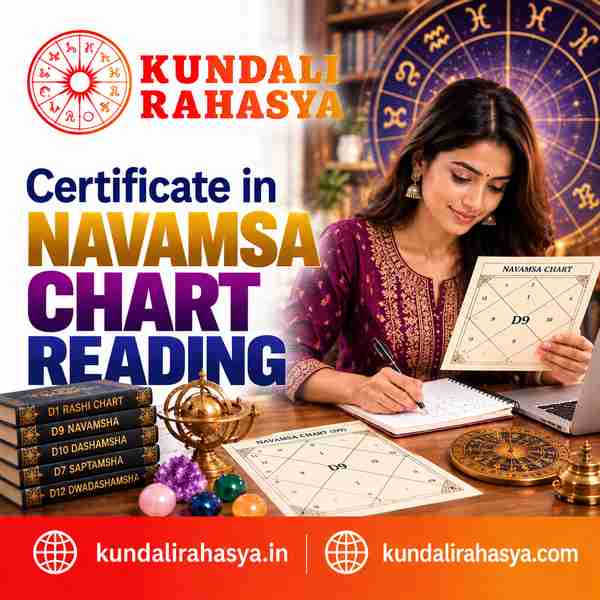
Description
Course Name: Certificate in Navamsa Chart Reading
The Certificate in Navamsa Chart Reading is designed for learners who want to understand the structure and traditional interpretation of the Navamsa or D9 chart within Vedic astrology. The course introduces divisional-chart concepts, zodiac signs, planetary placements, houses, the Navamsa Ascendant, planetary dignity, and the relationship between the birth chart and Navamsa chart.
Through six learning modules, students explore Jyotish fundamentals, the purpose of the D9 chart, planetary influences, house interpretation, introductory chart-comparison methods, and practical Navamsa-reading exercises. The programme emphasizes systematic observation and responsible interpretation without treating astrological placements as scientifically established predictions.
Course Details
- Course Name: Certificate in Navamsa Chart Reading
- Course Code: KR/CA/NCR/071
- Course Level: Professional Certificate
- Eligibility: 10th Pass or Equivalent
- Duration: 3 Months
- Learning Mode: Online / Self-Paced / Recorded Lectures
- Examination Mode: Online MCQ Examination
- Certificate Validity: Lifetime
- Certificate Verification: Online Verification Facility
About the Navamsa Chart Reading Course
The Navamsa, commonly known as the D9 chart, is a divisional chart used in traditional Vedic astrology alongside the main birth chart, or D1/Rashi chart. Learners are introduced to its layout, signs, houses, planetary placements, and the traditional concepts used to examine planetary dignity and chart relationships.
This course provides an introductory, step-by-step approach to reading a Navamsa chart. Students practise identifying chart components, observing planetary placements, and comparing relevant factors with the birth chart. The programme is suitable for learners who want to develop foundational knowledge before progressing to more specialized Navamsa analysis.
Course Objective
The objective is to develop foundational knowledge of Navamsa chart reading and introduce learners to a structured approach to examining the D9 chart within the broader horoscope. Learners will study:
Fundamentals and terminology of Navamsa chart reading
The purpose and structure of the Navamsa or D9 chart
The twelve signs and twelve houses in Navamsa
The Navamsa Ascendant and its traditional significance
Planetary placements and basic significations
Introductory planetary dignity concepts
House lords, aspects, and conjunctions
The relationship between the Rashi and Navamsa charts
Introduction to Vargottama and related concepts
Basic methods for reading a Navamsa chart
Practical D1 and D9 chart comparison exercises
Responsible interpretation and ethical communication
Admission, Learning, Examination & Certification Process
1. Select Your Course
Review the course details, eligibility criteria, duration, and learning objectives before selecting the Certificate in Navamsa Chart Reading.
2. Complete Online Enrollment
Submit the required information through the online enrollment process.
3. Make Secure Payment
Pay the applicable course fee using the payment options provided by the platform.
4. Receive Learning Access
Follow the provided instructions to access the course material and recorded lectures.
5. Study Online
Complete the modules at your own pace, revise important concepts, and practise reading sample Navamsa charts.
6. Appear for the Online Examination
Attempt the prescribed online MCQ examination according to the course instructions.
7. Receive Your Certificate
Learners who fulfil the applicable course completion and examination requirements may receive their certificate.
8. Online Certificate Verification
Use the available online verification facility to check the certificate details recorded by the provider.
9. Career Guidance & Job Assistance
Where available, learners may receive general guidance about further study and possible astrology-related career pathways. Employment or client placement is not guaranteed.
Who Should Enroll in the Certificate in Navamsa Chart Reading?
This course is suitable for beginners, astrology students, horoscope readers, and learners interested in understanding the traditional use of the Navamsa chart. It may also benefit learners who know basic astrology and want to explore divisional charts before pursuing specialized study. An interest in chart reading and regular practice is helpful, while advanced Navamsa knowledge is not required.
Core Learning Areas
1. Navamsa Chart Reading Foundations
Understand the meaning, traditional scope, and essential terminology of the Navamsa chart. Learn how the D9 chart is organized and how it is traditionally considered alongside the main birth chart.
2. Signs, Houses, and Navamsa Ascendant
Study the twelve signs and twelve houses in the Navamsa chart. Learn to identify the Navamsa Ascendant and recognize the general themes traditionally associated with chart placements.
3. Planetary Placements and Dignity
Explore planetary placements in Navamsa and introductory concepts of exaltation, debilitation, own-sign placement, and planetary dignity within the traditional interpretive framework.
4. House Lords and Planetary Relationships
Receive an introduction to house lords, planetary aspects, conjunctions, and relationships between signs and planets. Learn why chart factors should be considered together rather than in isolation.
5. Rashi and Navamsa Chart Comparison
Learn the basic purpose of comparing the D1/Rashi chart with the D9/Navamsa chart. Practise organizing observations across both charts while recognizing the limitations of simplified conclusions.
6. Practical Navamsa Chart Reading Exercises
Apply course concepts to sample charts, identify placements, compare relevant chart factors, record observations, and practise explaining introductory interpretations clearly and responsibly.
Certificate in Navamsa Chart Reading Syllabus
Module 1: Introduction to Jyotish and Navamsa
Meaning and scope of Vedic astrology, essential terminology, introduction to divisional charts, the traditional purpose of Navamsa, D9 chart structure, and basic chart-reading principles.
Module 2: Signs, Houses, and Navamsa Ascendant
The twelve signs and houses in Navamsa, identifying the Navamsa Ascendant, introductory house significations, planetary placements by sign and house, and basic chart-layout practice.
Module 3: Planetary Placements and Dignity
Traditional planetary significations in Navamsa, sign placements, introductory concepts of exaltation and debilitation, own-sign and other dignity conditions, and the importance of chart context.
Module 4: House Lords and Planetary Relationships
Introduction to house lords, planetary aspects, conjunctions, relationships between signs and planets, and basic methods for organizing Navamsa observations.
Module 5: Rashi–Navamsa Comparison
The relationship between the D1/Rashi and D9/Navamsa charts, comparing planetary placements, introduction to Vargottama, identifying repeated themes, and avoiding isolated interpretations.
Module 6: Practical Navamsa Chart Reading Exercises
Step-by-step sample-chart reviews, identification of signs and houses, planetary-placement exercises, introductory D1 and D9 comparisons, structured observation notes, and responsible communication.
Navamsa Chart Reading Assessment Framework
1. Fundamental Knowledge
Assess understanding of Navamsa terminology, divisional-chart concepts, and the general structure and traditional purpose of the D9 chart.
2. Sign and House Identification
Evaluate the ability to identify signs, houses, and the Navamsa Ascendant in sample charts.
3. Planetary Placement Knowledge
Review understanding of planetary placements and introductory concepts of planetary dignity in Navamsa.
4. House Lord and Relationship Knowledge
Assess introductory understanding of house lords, aspects, conjunctions, and relationships between chart components.
5. Rashi–Navamsa Comparison
Evaluate the ability to organize basic observations from the D1 and D9 charts without treating either chart in isolation.
6. Practical Navamsa Exercise
Review sample chart readings for organization, relevance, consistent reasoning, and acknowledgement of interpretive limitations.
7. Final Online MCQ Examination
Measure overall understanding of the course material through the prescribed online multiple-choice examination.
Certification Process
Learners who complete the required learning activities and meet the applicable assessment criteria may receive the Certificate in Navamsa Chart Reading. Certificate issuance is subject to the provider’s course completion and examination requirements. The certificate confirms course completion and does not guarantee professional competence, employment, clients, or predictive accuracy.
Career Opportunities
Navamsa Chart Study and Practice
Learners may use the course as a foundation for continued study and for developing introductory Navamsa chart-reading skills through further learning and practice.
Astrology Consultation Support
With additional study and suitable experience, learners may explore introductory astrology-related services or assist with organizing horoscope information within the limits of their competence.
Astrology Education and Content Creation
Learners may develop introductory articles, study notes, workshops, or educational material explaining divisional charts, Navamsa structure, planetary placements, and basic chart-reading methods.
Scope for Independent Navamsa Chart Reading Practice
With continued study and practical experience, learners may gradually develop activities involving:
Basic identification of signs, houses, and the Navamsa Ascendant
Introductory reviews of planetary placements in the D9 chart
Basic comparison of relevant placements in D1 and D9
Educational notes on Navamsa terminology and structure
Introductory explanations of traditional planetary dignity concepts
Basic astrology discussions within the limits of their competence
Independent practice requires continued learning, transparent communication, and responsible handling of client expectations. Interpretations should be explained without guarantees, fear-based claims, or pressure to purchase rituals or products. Astrology should not replace qualified medical, legal, financial, psychological, or other professional advice.
Expected Income & Earning Potential
Income from astrology-related work depends on experience, service quality, client demand, audience reach, professional reputation, pricing, and time invested. Completing a certificate does not guarantee employment, clients, or a particular income.
Indicative ranges:
- Beginner / Entry-Level: ₹2,50,000–₹5,00,000 per year
- Experienced Consultant: ₹5,00,000–₹10,00,000 per year
- Independent Practitioner: ₹7,00,000–₹15,00,000+ per year
- Established Professional: ₹12,00,000–₹20,00,000+ per year
These figures are illustrative possibilities for astrology-related work, not verified salary benchmarks or guaranteed earnings. Actual income may vary considerably, and some learners may not earn income from the subject.
Why Choose a Certificate in Navamsa Chart Reading?
This course introduces essential Navamsa concepts through the D9 chart structure, signs, houses, planetary placements, dignity, and comparison with the Rashi chart. Its six-module structure helps learners build knowledge progressively and practise organizing observations across chart factors rather than relying on isolated placements.
The online, self-paced format allows learners to revisit lessons and practise with sample Navamsa charts. By emphasizing systematic observation, clear explanations, and responsible interpretation, the programme provides a foundation for further study in Vedic astrology and specialized divisional-chart analysis.
Frequently Asked Questions
What is a Certificate in Navamsa Chart Reading?
It is a course that introduces foundational methods of reading the Navamsa or D9 chart within the traditional framework of Vedic astrology.
Can I learn Navamsa Chart Reading online?
Yes. The programme is designed for online, self-paced study using recorded learning material, subject to the platform’s access arrangements.
What practical skills will I develop?
You will practise identifying signs, houses, the Navamsa Ascendant, and planetary placements, and learn to compare introductory observations from the D1 and D9 charts.
What is the eligibility?
The stated eligibility is 10th Pass or Equivalent. No advanced Navamsa knowledge is required.
Is the examination conducted online?
Yes. The stated examination mode is an online MCQ examination, subject to the provider’s instructions.
Can I become a Navamsa Chart Reading Consultant after completing this course?
The course can provide a foundation for further learning and practice. Professional readiness depends on experience, broader astrological knowledge, communication skills, and responsible conduct; certification does not guarantee employment or clients.
Is the certificate verifiable online?
An online certificate verification facility is listed for the programme. Verification is subject to the provider’s process and the certificate details recorded in its system.
Who can join this course?
Beginners, astrology students, horoscope readers, and interested learners who meet the stated eligibility may enrol.
