Kundali Rahasya – India’s Trusted App for Astrology Consultations
kundalirahasya108@gmail.com

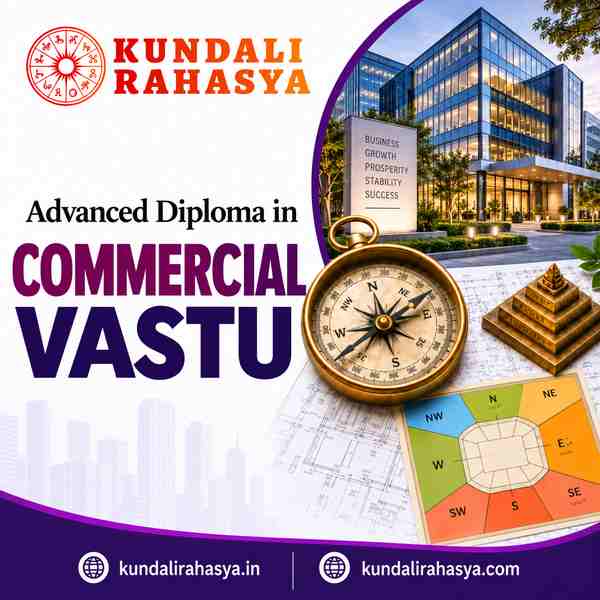
Advanced Diploma in Commercial Vastu

Original price was: ₹11,500.Current price is: ₹5,750.

The course combines classical Vastu Shastra principles with advanced commercial-space planning, site and plot assessment, directional and five-element analysis, Vastu Purusha Mandala application, entrance and reception placement, workspace and customer-area orientation, circulation and utility-zone planning, business-oriented spatial analysis, energy-flow evaluation, structural Vastu considerations, case-study research, design assessment, report-writing and professional consultation practices. Learners can study through online resources and recorded lectures at their own pace.

Description

Course Name: Advanced Diploma in Commercial Vastu

Develop a comprehensive understanding of the foundational and advanced principles of Commercial Vastu and traditional Vastu Shastra techniques for systematically studying commercial directions, spatial arrangements, Vastu Purusha, five elements, eight directions, ten directions, Brahmasthan, zones, energy fields, entrances, shops, offices, showrooms, commercial buildings, workspaces, customer movement, employee areas, management spaces, storage, display areas, business environments, plots, structures, environmental influences, elemental balance, directional strengths, defects, corrections, remedies, energy flow, commercial planning, property assessment, structural assessment, business-related Vastu considerations, and other essential Vastu factors with the Advanced Diploma in Commercial Vastu. This advanced online program introduces learners to Commercial Vastu terminology, Vastu principles, directional energies, Panch Mahabhutas, Vastu Purusha Mandala, zones and sub-zones, commercial property analysis, entrance analysis, workspace placement, energy distribution, elemental imbalances, directional defects, structural considerations, environmental factors, Vastu assessment methods, traditional remedies, practical commercial property analysis, case studies, report preparation, and responsible application of belief-based Vastu observations.

Course Details

Course Name: Advanced Diploma in Commercial Vastu
Course Code: CVA/ADE/A26
Course Level: Advanced Diploma
Eligibility: 12th Pass or Equivalent
Duration: 6 Months
Learning Mode: Online / Self-Paced / Recorded Lectures
Examination Mode: Online MCQ Examination
Certificate Validity: Lifetime
Certificate Verification: Online Verification Facility

About the Course

Commercial Vastu is traditionally associated with the study of commercial spatial arrangements, directional influences, elemental balance, energy flow, and the relationship between business environments and traditional Vastu principles. The Advanced Diploma in Commercial Vastu is designed to provide learners with a structured foundation in advanced concepts required to understand and study traditional Commercial Vastu.

The program introduces learners to the essential framework of Vastu Shastra and explains the traditional significance of the five elements, eight and ten directions, Vastu Purusha Mandala, Brahmasthan, directional zones, planetary associations, spatial energies, commercial entrances, shops, showrooms, offices, workspaces, customer areas, employee seating, management spaces, storage, display areas, and business-related considerations.

Learners explore traditional Vastu principles and understand how commercial conditions may be studied through directions, elements, zones, proportions, entrances, workspace placements, structural layouts, surrounding environments, property characteristics, energy movement, customer circulation, business activity, and other Vastu factors. The program also introduces traditional considerations involving elemental imbalance, directional defects, energy blockages, structural irregularities, commercial usage, customer movement, employee productivity, management positions, financial activity, and relationships between different areas of a commercial environment.

The program covers foundational and advanced Commercial Vastu considerations related to shops, showrooms, offices, commercial buildings, entrances, reception areas, workstations, management cabins, meeting areas, customer movement, display areas, billing counters, cash areas, storage areas, employee spaces, business environments, productivity, communication, stability, prosperity, commercial growth, property planning, and other themes traditionally examined through Vastu principles. Learners are introduced to traditional approaches for studying possible spatial influences through directional energies, Panch Mahabhutas, Vastu Purusha Mandala, zones, elemental balance, structural placement, and traditional remedial concepts.

Through practical commercial property examples and advanced exercises, learners can develop familiarity with identifying directions, mapping Vastu zones, studying commercial property characteristics, observing entrances, assessing workspaces, analyzing management and customer areas, evaluating elemental balance, identifying traditional Vastu defects, evaluating energy flow, studying surrounding influences, comparing alternative commercial layouts, organizing property observations, and preparing basic Commercial Vastu reports. The program also introduces traditional remedial concepts, commercial property assessment, Vastu report preparation, case-based analysis, and responsible communication of belief-based Vastu observations.

Course Objectives

After completing this program, learners should have a better understanding of:

Foundations and principles of Commercial Vastu
Advanced Vastu Shastra fundamentals
Meaning and traditional significance of Commercial Vastu
Basic Commercial Vastu terminology
Vastu Purusha fundamentals
Vastu Purusha Mandala fundamentals
Panch Mahabhuta fundamentals
Earth element fundamentals
Water element fundamentals
Fire element fundamentals
Air element fundamentals
Space element fundamentals
Eight-direction fundamentals
Ten-direction fundamentals
East direction fundamentals
West direction fundamentals
North direction fundamentals
South direction fundamentals
Northeast direction fundamentals
Northwest direction fundamentals
Southeast direction fundamentals
Southwest direction fundamentals
Directional energy fundamentals
Directional lordship fundamentals
Vastu zone fundamentals
Sub-zone fundamentals
Brahmasthan fundamentals
Commercial property fundamentals
Commercial layout fundamentals
Commercial space shape fundamentals
Commercial property slope fundamentals
Road and surrounding environment fundamentals
Entrance fundamentals
Main entrance analysis
Workspace placement fundamentals
Shop and showroom fundamentals
Office space fundamentals
Reception area fundamentals
Customer movement fundamentals
Billing and cash area fundamentals
Storage area fundamentals
Commercial space fundamentals
Office Vastu fundamentals
Workplace Vastu fundamentals
Property assessment fundamentals
Spatial energy fundamentals
Energy flow fundamentals
Elemental balance fundamentals
Directional balance fundamentals
Vastu defect identification fundamentals
Structural Vastu fundamentals
Environmental Vastu fundamentals
Residential Vastu fundamentals
Commercial Vastu fundamentals
Workplace energy fundamentals
Business-related Vastu considerations
Career-related Vastu considerations
Financial and prosperity-related considerations
Family and domestic considerations
Health and wellbeing-related considerations
Education-related considerations
Property and commercial space-related considerations
Traditional remedial concepts
Vastu correction fundamentals
Vastu assessment principles
Vastu report preparation fundamentals
Practical Commercial Vastu techniques
Basic commercial property reading principles
Advanced Vastu observation and synthesis
Responsible communication of Vastu-based observations
Practical application of advanced Commercial Vastu principles

Who Should Enroll?

This program may be suitable for:

Students who want to learn Commercial Vastu from foundational to advanced concepts
Beginners and intermediate learners interested in studying Commercial Vastu systematically
Vastu learners seeking a structured advanced foundation in commercial Vastu principles
Individuals interested in understanding commercial directions and elemental balance
Learners interested in traditional Vastu-based commercial property assessment
Individuals exploring shops, showrooms, offices, and commercial building Vastu analysis
Students planning to pursue advanced Commercial Vastu consultation studies
Vastu enthusiasts interested in learning practical commercial energy analysis principles
Individuals interested in developing commercial property assessment and Vastu report preparation skills

No advanced professional Vastu experience is required. Basic familiarity with directions, commercial properties, floor plans, and Vastu concepts may be helpful but is not mandatory.

Key Skills You Will Develop

Foundations of Commercial Vastu

Develop a comprehensive understanding of Commercial Vastu, Vastu Shastra, directional energies, Panch Mahabhutas, Vastu Purusha, zones, spatial arrangements, energy flow, structural factors, and other principles used in traditional commercial Vastu study.

Advanced Vastu Fundamentals

Learn the advanced framework of Commercial Vastu and understand how commercial arrangements, directional energies, elemental balance, and structural conditions may traditionally be studied together.

Commercial Vastu Terminology

Become familiar with commonly used terms relating to Vastu Purusha, directions, elements, zones, Brahmasthan, entrances, shops, showrooms, offices, workspaces, energy fields, defects, corrections, remedies, commercial property assessment, and traditional Vastu concepts.

Vastu Purusha Fundamentals

Understand the traditional concept of Vastu Purusha and study its relationship with commercial planning, directional divisions, zones, and the organization of a commercial property.

Vastu Purusha Mandala Fundamentals

Learn the basic structure and traditional significance of the Vastu Purusha Mandala and understand how commercial areas may be organized according to traditional Vastu principles.

Panch Mahabhuta Fundamentals

Study the traditional five elements—Earth, Water, Fire, Air, and Space—and understand their relationship with directional zones and commercial energy assessment.

Earth Element Fundamentals

Understand traditional Vastu considerations associated with Earth, including stability, grounding, support, heaviness, structure, and suitable commercial spatial characteristics.

Water Element Fundamentals

Explore traditional Vastu considerations associated with Water, including flow, receptivity, movement, abundance, cooling qualities, and commercial spatial placement.

Fire Element Fundamentals

Study traditional considerations associated with Fire, including heat, activity, transformation, vitality, energy, electrical equipment, cooking areas, and appropriate commercial spatial relationships.

Air Element Fundamentals

Understand traditional considerations associated with Air, including movement, circulation, communication, activity, openness, ventilation, customer movement, and commercial energy flow.

Space Element Fundamentals

Learn traditional considerations associated with Space, including openness, expansion, central areas, circulation, subtle energy, and commercial spatial balance.

Directional Energy Fundamentals

Explore the traditional energetic characteristics associated with the principal directions and understand how directional placement may be considered during Commercial Vastu assessment.

Eight-Direction Fundamentals

Study the eight primary directions and understand their traditional significance in relation to spatial functions, elements, energies, and commercial property planning.

Ten-Direction Fundamentals

Learn the traditional concept of ten directional influences, including the principal directions and their broader spatial relationships in Commercial Vastu analysis.

East Direction Fundamentals

Understand traditional considerations associated with the East direction and its relationship with light, vitality, beginnings, openness, visibility, and commercial functions.

West Direction Fundamentals

Study traditional considerations associated with the West direction and understand its relationship with stability, completion, storage, authority, and other commercial spatial themes.

North Direction Fundamentals

Explore traditional considerations associated with the North direction and its traditional relationship with movement, opportunities, resources, trade, and prosperity-related commercial themes.

South Direction Fundamentals

Understand traditional considerations associated with the South direction and its relationship with stability, strength, structure, responsibilities, authority, and commercial spatial balance.

Northeast Direction Fundamentals

Learn traditional considerations associated with the Northeast direction and its relationship with spirituality, openness, water-related symbolism, learning, clarity, and subtle commercial energy.

Northwest Direction Fundamentals

Study traditional considerations associated with the Northwest direction and its relationship with movement, change, circulation, travel, customer activity, and dynamic commercial functions.

Southeast Direction Fundamentals

Understand traditional considerations associated with the Southeast direction and its relationship with Fire, activity, transformation, electrical functions, commercial activity, and energetic intensity.

Southwest Direction Fundamentals

Explore traditional considerations associated with the Southwest direction and its relationship with stability, grounding, responsibility, authority, weight, and long-term commercial qualities.

Vastu Zone Fundamentals

Learn how a commercial property may traditionally be divided into directional zones and understand how different activities and commercial functions may be considered within those zones.

Sub-Zone Fundamentals

Study smaller directional divisions and understand how detailed commercial spatial analysis may be organized using traditional Vastu sub-zone principles.

Brahmasthan Fundamentals

Understand the traditional significance of the central portion of a commercial property and why openness, balance, circulation, and spatial organization may be considered around the Brahmasthan.

Plot Fundamentals

Explore traditional considerations involving commercial plot orientation, dimensions, shape, access, surroundings, slope, and other characteristics used during preliminary Vastu assessment.

Landform Fundamentals

Study traditional considerations involving land levels, natural formations, slopes, elevations, depressions, surrounding structures, and environmental conditions affecting commercial properties.

Plot Shape Fundamentals

Understand how square, rectangular, irregular, extended, cut, and other traditional plot-shape considerations may be studied during Commercial Vastu assessment.

Plot Slope Fundamentals

Learn traditional approaches to observing the slope and level differences of a commercial property and understanding their relationship with directional and elemental considerations.

Road and Surrounding Environment Fundamentals

Study traditional considerations involving roads, adjoining properties, open spaces, water bodies, structures, pathways, surroundings, customer access, and environmental influences.

Entrance Fundamentals

Understand why the main entrance is traditionally considered an important factor in Commercial Vastu and how its direction, placement, surroundings, visibility, and usage may be studied.

Main Entrance Analysis

Develop the ability to observe the main commercial entrance in relation to directions, zones, pathways, surrounding structures, internal circulation, customer movement, and traditional Vastu principles.

Room Placement Fundamentals

Study traditional approaches to evaluating the placement of different rooms and commercial functions according to directions, elements, zones, usage, and spatial relationships.

Bedroom Fundamentals

Understand traditional considerations involving accommodation or residential areas attached to commercial properties, sleeping direction, room location, privacy, stability, comfort, and spatial balance.

Living Room Fundamentals

Explore traditional considerations involving common areas, seating arrangements, openness, circulation, social interaction, and directional placement within mixed-use or commercial properties.

Kitchen Fundamentals

Study traditional considerations involving kitchen placement, Fire element symbolism, cooking activity, appliances, ventilation, and relationship with other commercial areas.

Study Room Fundamentals

Understand traditional considerations involving study and training spaces, concentration, learning, orientation, seating direction, lighting, and spatial organization.

Puja and Meditation Space Fundamentals

Learn traditional considerations involving prayer, meditation, spiritual practices, sacred spaces, orientation, cleanliness, openness, and suitable placement within commercial properties.

Bathroom Fundamentals

Study traditional considerations involving commercial bathrooms, water usage, drainage, ventilation, placement, and relationship with surrounding spaces.

Toilet Placement Fundamentals

Understand traditional Vastu considerations involving toilet placement, drainage, ventilation, direction, and separation from important commercial spatial zones.

Staircase Fundamentals

Explore traditional considerations involving staircase placement, direction of movement, structural weight, circulation, and relationship with other areas of a commercial property.

Storage Area Fundamentals

Learn traditional considerations involving commercial storage, heavy materials, inventory, unused spaces, clutter, organization, records, and appropriate placement of stored items.

Commercial Space Fundamentals

Understand traditional Vastu approaches to shops, showrooms, commercial properties, customer movement, entrances, work areas, storage, display areas, billing spaces, and business-related spatial arrangements.

Office Vastu Fundamentals

Study traditional considerations involving office entrances, workstations, leadership positions, meeting areas, reception spaces, storage, accounting areas, and workplace organization within commercial properties.

Workplace Vastu Fundamentals

Explore traditional considerations involving employee seating, communication areas, productivity zones, circulation, management spaces, and workplace energy.

Property Assessment Fundamentals

Develop a structured approach to reviewing commercial property orientation, plot characteristics, entrance placement, room and workspace distribution, directions, elements, zones, surroundings, and structural conditions.

Spatial Energy Fundamentals

Understand traditional concepts of spatial energy and how directional arrangements, elements, movement, openness, usage, and structural characteristics may be considered together within commercial spaces.

Energy Flow Fundamentals

Study traditional approaches to observing customer circulation, employee movement, openness, blockages, pathways, entrances, internal arrangements, and perceived energy flow within a commercial property.

Elemental Balance Fundamentals

Learn how Earth, Water, Fire, Air, and Space may traditionally be assessed in relation to directional zones, commercial functions, property conditions, and spatial balance.

Directional Balance Fundamentals

Understand how the relative strength, openness, weight, activity, and usage of different directions may traditionally be considered during Commercial Vastu assessment.

Vastu Defect Identification Fundamentals

Study traditional approaches to identifying commonly discussed Vastu defects involving directions, entrances, workspace placement, elemental imbalance, structural conditions, and commercial spatial irregularities.

Structural Vastu Fundamentals

Understand traditional considerations involving commercial building structure, walls, columns, beams, levels, openings, staircases, extensions, cuts, and internal spatial organization.

Environmental Vastu Fundamentals

Explore traditional considerations involving natural light, ventilation, surroundings, roads, open areas, water features, neighboring structures, customer access, and environmental influences.

Residential Vastu Fundamentals

Study traditional Vastu considerations for residential areas associated with commercial properties, including entrances, bedrooms, kitchens, living spaces, bathrooms, study areas, prayer spaces, and family-oriented functions.

Commercial Vastu Fundamentals

Understand traditional considerations for shops, showrooms, offices, commercial buildings, business premises, customer movement, employee areas, entrances, storage, display, billing, and activity zones.

Workplace Energy Fundamentals

Learn traditional approaches to studying workplace energy, seating arrangements, leadership areas, communication, productivity, employee movement, and organizational spaces.

Business-Related Vastu Fundamentals

Explore traditional considerations involving business activity, customer flow, financial zones, entrances, workspaces, storage, display areas, billing counters, decision-making spaces, and commercial development.

Career-Related Vastu Fundamentals

Study traditional considerations associated with professional environments, workspaces, leadership positions, productivity, responsibilities, opportunities, and career-oriented commercial arrangements.

Financial and Prosperity Fundamentals

Understand traditional considerations involving wealth-related zones, resource management, storage, business activity, entrances, financial symbolism, billing areas, and prosperity-oriented commercial concepts.

Family and Domestic Fundamentals

Explore traditional considerations associated with family circumstances, domestic harmony, household relationships, privacy, shared spaces, responsibilities, and residential arrangements where commercial and domestic spaces coexist.

Education Fundamentals

Understand traditional considerations involving training spaces, study areas, concentration, learning, academic development, reading areas, orientation, lighting, and educational commercial environments.

Property and Residence Fundamentals

Study traditional considerations involving commercial property selection, residence planning, relocation, construction, land, buildings, workspace placement, and mixed-use environments.

Vastu Assessment and Synthesis

Learn how directions, elements, zones, entrances, workspaces, commercial functions, plot characteristics, structural conditions, environmental factors, and traditional remedies may be considered together rather than relying on a single Vastu factor.

Basic Vastu Property Reading

Develop the ability to identify directions, map major zones, review a basic commercial floor plan, observe entrances, classify commercial areas, and organize important Vastu observations before attempting traditional interpretation.

Practical Commercial Vastu Fundamentals

Develop advanced foundational skills for applying Commercial Vastu principles to shops, showrooms, offices, commercial buildings, floor plans, plot layouts, case-based exercises, and traditional Vastu assessments.

Remedial Vastu Fundamentals

Study the basic concept of traditional Vastu remedies and corrections associated with directional, elemental, structural, and spatial concerns and understand their belief-based nature.

Advanced Diploma in Commercial Vastu Syllabus

Module 1: Foundations of Commercial Vastu, Vastu Purusha and Spatial Energy

Introduction to Commercial Vastu, basic terminology, Vastu Shastra principles, Vastu Purusha, Vastu Purusha Mandala, Panch Mahabhutas, eight and ten directions, directional energies, Brahmasthan, zones, spatial energy, and the basic framework used for traditional Commercial Vastu assessment.

Module 2: Directions, Elements, Zones, Plots and Commercial Property Fundamentals

Detailed study of East, West, North, South, Northeast, Northwest, Southeast, Southwest, elemental classifications, directional relationships, Vastu zones, sub-zones, plot orientation, plot shape, landform, slope, roads, surroundings, entrances, and traditional approaches to analyzing commercial property characteristics.

Module 3: Commercial Planning, Workspaces, Structures and Energy Flow

Study of main entrances, shops, showrooms, workspaces, offices, reception areas, customer movement, billing areas, storage areas, structural arrangements, internal circulation, energy flow, elemental balance, directional balance, environmental factors, and other foundational principles relevant to Commercial Vastu.

Module 4: Commercial Vastu for Business, Offices and Workplace Spaces

Introduction to traditional Vastu considerations involving shops, showrooms, commercial buildings, offices, workplaces, business environments, career-related spaces, finances, customer movement, employee areas, productivity, property, residence, and other commercial activity themes.

Module 5: Vastu Defects, Assessment, Corrections and Traditional Remedies

Introduction to Vastu defect identification, directional imbalance, elemental imbalance, structural irregularities, entrance concerns, plot considerations, commercial layout issues, workspace placement concerns, environmental factors, energy blockages, traditional correction principles, remedial concepts, commercial property assessment, and responsible interpretation of Vastu observations.

Module 6: Practical Commercial Vastu, Case Studies and Report Preparation

Practical application of advanced Commercial Vastu through direction identification, Vastu zone mapping, Vastu Purusha Mandala observation, Panch Mahabhuta assessment, plot analysis, entrance analysis, commercial layout review, workspace placement review, customer movement observation, elemental balance assessment, directional analysis, energy flow observation, defect identification, traditional remedies, shop, showroom, office and commercial case studies, floor-plan exercises, Vastu report preparation, and responsible presentation of belief-based observations.

Admission, Learning, Examination and Certification Process

Step 1: Course Enrollment

Complete the online admission process for the Advanced Diploma in Commercial Vastu and provide the required learner information.

Step 2: Learning Access

After enrollment, learners receive access to the online learning environment and available recorded course materials.

Step 3: Self-Paced Study

Study the program modules according to your preferred schedule. Learners can review recorded lectures and course material during the available learning period.

Step 4: Advanced Foundational Learning

Apply Commercial Vastu concepts through direction identification, Vastu Purusha study, Panch Mahabhuta analysis, zone mapping, Brahmasthan observation, plot assessment, entrance analysis, commercial layout study, workspace placement, customer movement observation, elemental balance, directional balance, structural assessment, energy flow observation, Vastu defect identification, traditional remedies, shop, showroom, office and commercial case studies, and practical Vastu exercises.

Step 5: Course Completion

Complete the prescribed learning material and prepare for the online assessment after studying the program modules.

Step 6: Online Examination

Appear for the online MCQ examination according to the applicable examination process.

Step 7: Evaluation

The submitted examination is evaluated according to the prescribed assessment criteria.

Step 8: Certificate Issuance

Eligible learners who successfully complete the program and assessment requirements receive the Advanced Diploma in Commercial Vastu.

Step 9: Certificate Verification

The certificate can be checked through the available online certificate verification facility.

Certificate Delivery

Digital certificate may be provided through the applicable online delivery process.
Certificate details can be used for online verification where the verification facility is available.
Certificate validity is lifetime.
Learners should retain their certificate details for future verification or educational documentation.

Career Opportunities

The knowledge developed through this advanced program may support further learning and development in areas such as:

Commercial Vastu Learner
Advanced Vastu Student
Vastu Shastra Student
Commercial Vastu Study Assistant
Vastu Energy Research Assistant
Vastu Content Writer
Vastu Content Developer
Commercial Vastu Analysis Trainee
Shop Vastu Study Practitioner
Showroom Vastu Study Practitioner
Commercial Property Assessment Assistant
Vastu Report Preparation Assistant
Vastu Education Assistant
Commercial Vastu Energy Researcher
Traditional Vastu Learner
Vastu Consultation Course Student
Independent Vastu Learner

The program is primarily designed to establish advanced foundational knowledge. Learners interested in professional Commercial Vastu or Vastu consultation practice may continue with specialized education, practical training, field experience, and advanced Vastu programs.

Scope for Independent Practice

Learners may explore foundational and advanced activities involving:

Basic Commercial Vastu study
Advanced Vastu Shastra study
Vastu Purusha study
Vastu Purusha Mandala study
Panch Mahabhuta study
Earth element study
Water element study
Fire element study
Air element study
Space element study
Eight-direction study
Ten-direction study
East direction study
West direction study
North direction study
South direction study
Northeast direction study
Northwest direction study
Southeast direction study
Southwest direction study
Directional energy observation
Directional lordship study
Vastu zone study
Sub-zone study
Brahmasthan study
Commercial property orientation study
Commercial layout study
Plot shape study
Landform study
Plot slope study
Road and surrounding environment study
Main entrance study
Commercial space placement study
Shop Vastu study
Showroom Vastu study
Office Vastu study
Reception area Vastu study
Customer movement Vastu study
Billing and cash area Vastu study
Storage area Vastu study
Commercial Vastu study
Workplace Vastu study
Property assessment study
Spatial energy study
Energy flow observation
Elemental balance study
Directional balance study
Vastu defect identification
Structural Vastu study
Environmental Vastu study
Business-related Vastu study
Career-related Vastu study
Financial and prosperity-related Vastu study
Family and domestic Vastu study
Education-related Vastu study
Property and commercial space study
Traditional Vastu remedial study
Vastu correction study
Basic Vastu report organization
Commercial floor-plan analysis study
Vastu learning and research
Further professional Vastu education

The program provides educational knowledge and advanced foundational exposure to traditional Commercial Vastu and Vastu Shastra principles, Vastu Purusha, Vastu Purusha Mandala, Panch Mahabhutas, directions, directional energies, zones, Brahmasthan, plots, landforms, entrances, shops, showrooms, offices, workspaces, customer movement, employee areas, structural arrangements, energy flow, elemental balance, directional balance, commercial Vastu, workplace Vastu, business-related Vastu, property assessment, Vastu defects, traditional corrections, remedial concepts, case studies, and basic Commercial Vastu interpretation. Vastu interpretations are belief-based and should not be understood as scientifically proven guarantees of specific outcomes. Results or experiences may vary, and the program does not guarantee particular personal, financial, professional, career, social, relationship, health, property, business, construction, productivity, customer, sales, or other outcomes. Vastu-based guidance should not be used as a substitute for qualified financial, medical, psychological, legal, architectural, construction, engineering, business, accounting, or other professional advice.

Frequently Asked Questions

What is the Advanced Diploma in Commercial Vastu?

The Advanced Diploma in Commercial Vastu is an advanced online program designed to introduce learners to essential and practical principles of traditional Commercial Vastu, including Vastu Purusha, Panch Mahabhutas, directions, zones, Brahmasthan, entrances, plots, shops, showrooms, offices, workspaces, customer movement, energy flow, elemental balance, property assessment, Vastu defects, traditional remedies, and practical Commercial Vastu interpretation.

How long is the program?

The program duration is 6 months. Learners can study through the available online, self-paced, and recorded learning format.

Who can enroll in this program?

The basic eligibility requirement is 12th Pass or Equivalent. The program is suitable for learners who want to build systematic and advanced foundational knowledge of Commercial Vastu.

Do I need previous Vastu knowledge?

No advanced professional Vastu experience is required. The program begins with foundational principles and gradually introduces learners to more detailed and practical Commercial Vastu concepts.

Is this program available online?

Yes. The program follows an online learning format with self-paced study and recorded lectures.

What are the foundations of Commercial Vastu?

The foundations include understanding Vastu Purusha, Vastu Purusha Mandala, Panch Mahabhutas, directions, directional energies, zones, Brahmasthan, plot characteristics, entrances, commercial layouts, workspaces, energy flow, elemental balance, structural considerations, Vastu defects, and other traditional Vastu principles.

What is Commercial Vastu?

Commercial Vastu is a traditional Vastu approach involving the study of commercial spatial arrangements, directional influences, elemental relationships, energy flow, property characteristics, customer movement, business activity, and built-environment factors according to traditional Vastu principles.

What is Vastu Purusha?

Vastu Purusha is a traditional Vastu concept associated with the energetic and symbolic organization of a built environment. The program introduces its traditional relationship with commercial planning and Vastu assessment.

What is the Vastu Purusha Mandala?

The Vastu Purusha Mandala is a traditional spatial framework used in Vastu Shastra to organize directional and elemental principles within a property. The program introduces its foundational application in Commercial Vastu.

What are the Panch Mahabhutas?

The Panch Mahabhutas are the five traditional elements of Earth, Water, Fire, Air, and Space. The program studies their traditional relationship with directions, zones, commercial functions, and spatial balance.

Does the program cover the eight directions?

Yes. The program introduces the eight primary directions and explains their traditional significance in relation to elements, energies, zones, and commercial spatial functions.

Does the program cover the ten directions?

Yes. Learners are introduced to the traditional concept of ten directional influences and their broader relationship with Vastu spatial analysis.

Does the program cover East direction?

Yes. The program introduces traditional East-direction considerations and their relationship with light, vitality, beginnings, openness, visibility, and commercial functions.

Does the program cover West direction?

Yes. The program introduces traditional West-direction considerations and their relationship with stability, completion, storage, authority, and other commercial spatial themes.

Does the program cover North direction?

Yes. The program introduces traditional North-direction considerations and their relationship with movement, opportunities, resources, trade, and prosperity-related commercial themes.

Does the program cover South direction?

Yes. The program introduces traditional South-direction considerations and their relationship with stability, strength, structure, responsibility, authority, and commercial spatial balance.

Does the program cover Northeast direction?

Yes. The program introduces traditional Northeast-direction considerations and their relationship with spirituality, openness, water-related symbolism, learning, clarity, and subtle commercial energy.

Does the program cover Northwest direction?

Yes. The program introduces traditional Northwest-direction considerations and their relationship with movement, change, circulation, travel, customer activity, and dynamic commercial functions.

Does the program cover Southeast direction?

Yes. The program introduces traditional Southeast-direction considerations and their relationship with Fire, activity, transformation, electrical functions, commercial activity, and energetic intensity.

Does the program cover Southwest direction?

Yes. The program introduces traditional Southwest-direction considerations and their relationship with stability, grounding, responsibility, authority, weight, and long-term commercial qualities.

Does the program cover Brahmasthan?

Yes. The program introduces the traditional concept of Brahmasthan and explains why the central portion of a commercial property may be considered in relation to openness, balance, circulation, and spatial organization.

Does the program cover plot analysis?

Yes. The program introduces traditional commercial plot assessment involving orientation, dimensions, shape, slope, access, surroundings, roads, landform, and other property characteristics.

Does the program cover main entrance analysis?

Yes. The program introduces traditional entrance considerations involving direction, placement, zones, pathways, surroundings, internal circulation, customer movement, and commercial property usage.

Does the program cover commercial space placement?

Yes. Learners are introduced to traditional approaches for studying shops, showrooms, offices, workspaces, reception areas, customer areas, billing spaces, storage areas, meeting spaces, and other commercial functions according to Vastu principles.

Does the program cover elemental balance?

Yes. The program introduces traditional approaches to studying the balance and placement of Earth, Water, Fire, Air, and Space within different commercial property areas.

Does the program cover directional balance?

Yes. Traditional considerations involving the relative openness, weight, activity, usage, and spatial characteristics of different directions are included.

Does the program cover energy flow?

Yes. The program introduces traditional concepts associated with customer circulation, employee movement, openness, pathways, entrances, internal arrangements, and perceived commercial spatial energy flow.

Does the program cover Vastu defects?

Yes. The program introduces traditional approaches to identifying directional, elemental, structural, entrance, commercial-layout, workspace-placement, plot, and environmental Vastu concerns.

Does the program cover Vastu remedies?

Yes. The program introduces traditional remedial and correction concepts associated with Vastu concerns and explains their belief-based nature.

Does the program cover commercial Vastu?

Yes. The program introduces traditional considerations for shops, showrooms, offices, commercial buildings, entrances, customer movement, work areas, storage, display spaces, billing areas, employee spaces, and business environments.

Does the program cover workplace Vastu?

Yes. Traditional considerations involving employee seating, management areas, workstations, communication spaces, circulation, productivity, and workplace organization are introduced.

Does the program cover business-related Vastu?

Yes. The program introduces traditional considerations involving business activity, customer flow, entrances, workspaces, resource-related areas, storage, display areas, billing spaces, and decision-making areas.

Does the program cover career-related Vastu?

Yes. Traditional considerations associated with professional environments, workspaces, leadership positions, productivity, responsibilities, opportunities, and career-oriented spatial arrangements are introduced.

Does the program cover financial and prosperity considerations?

Yes. Traditional considerations involving wealth-related zones, resources, storage, business activity, entrances, financial symbolism, billing areas, and prosperity-oriented spatial concepts are introduced.

Does the program cover family matters?

Yes. Basic traditional considerations associated with family circumstances, domestic harmony, household relationships, privacy, shared spaces, and family responsibilities are included.

Does the program cover education?

Yes. Traditional considerations associated with study spaces, concentration, learning, academic development, reading areas, orientation, lighting, and educational environments are introduced.

Does the program cover property and commercial space?

Yes. The program introduces traditional considerations involving commercial property selection, planning, relocation, construction, land, buildings, workspace placement, and commercial living or mixed-use environments.

Does the program cover environmental Vastu?

Yes. Traditional considerations involving natural light, ventilation, roads, open areas, water features, neighboring structures, surrounding properties, customer access, and environmental conditions are included.

Does the program teach Commercial Vastu identification?

The program introduces traditional Vastu assessment using directions, Vastu Purusha, Panch Mahabhutas, zones, Brahmasthan, plot characteristics, entrances, commercial layouts, workspaces, structural conditions, energy flow, elemental balance, directional balance, and other Vastu factors. Advanced professional techniques may require additional study and practical experience.

Does the program include practical Vastu examples?

Yes. The program includes commercial property examples, floor-plan exercises, shop and showroom examples, office examples, case studies, and foundational practical activities intended to help learners apply the concepts introduced in the modules.

Will I learn how to analyze a commercial property using Vastu principles?

The program develops foundational and advanced Vastu-related commercial property analysis skills, including identifying directions, mapping zones, studying the Vastu Purusha Mandala, assessing Panch Mahabhutas, reviewing plots and entrances, analyzing commercial layouts, observing workspaces and customer areas, evaluating elemental and directional balance, identifying traditional Vastu concerns, and organizing basic commercial property observations.

Can I become a professional Commercial Vastu practitioner after completing this program?

The program provides advanced foundational knowledge and may serve as a starting point for further Commercial Vastu and Vastu consultation education. Professional practice generally requires additional specialized study, practical field experience, commercial property assessment experience, and development of consultation skills.

Does the program guarantee success in Vastu practice?

No. Completion of the program does not guarantee professional success, income, clients, property outcomes, business results, sales, productivity, consultations, or any specific personal or professional outcome.

Does Commercial Vastu guarantee a specific outcome?

No. Commercial Vastu is a traditional, belief-based practice, and the program does not scientifically guarantee specific events, results, commercial outcomes, financial outcomes, health outcomes, business results, sales, productivity, or future outcomes.

Can Commercial Vastu replace professional advice?

No. Vastu-based observations should not replace qualified architectural, construction, engineering, structural, financial, accounting, medical, psychological, legal, career, business, or other professional advice when such advice is required.

Is the diploma valid for a lifetime?

Yes. The stated certificate validity for the program is Lifetime.

Can the diploma be verified online?

Yes. An Online Verification Facility is available for certificate verification as applicable.

Can I study the program at my own pace?

Yes. The learning mode is Online / Self-Paced / Recorded Lectures, allowing learners to organize their study according to their available schedule.

Student Reviews

Student feedback for Advanced Diploma in Commercial Vastu

4.7
4.7/5 Overall Rating
Based on 30 student reviews
K
Komal Mehta
Course Student
A very good learning experience. The course was informative, organized and easy to complete.
A
Amit Sharma
Course Student
The course was easy to understand and the lessons were explained in a simple way. I enjoyed learning through this course.
P
Priya Verma
Course Student
Very useful course for beginners. The study material helped me understand the important concepts clearly.
R
Rohit Kumar
Course Student
Good course and useful learning material. I was able to study comfortably at my own pace.
N
Neha Gupta
Course Student
I had a good learning experience. The course content was properly arranged and easy to follow.
S
Sanjay Patel
Course Student
The course helped me improve my knowledge. I especially liked the simple presentation of the topics.
P
Pooja Singh
Course Student
Overall a good course. The modules were useful and I could complete them according to my available time.
R
Rahul Jain
Course Student
The lessons were informative and beginner friendly. It was a positive learning experience for me.
A
Anjali Mehta
Course Student
I liked the course structure and the way every topic was presented step by step.
V
Vikas Yadav
Course Student
Useful course for gaining basic and practical knowledge. The online learning format was convenient.
K
Kavita Mishra
Course Student
The course was informative and easy to complete. I learned many useful concepts from the modules.
D
Deepak Tiwari
Course Student
A well-organized course with useful study material. It helped me improve my understanding of the subject.
R
Ritu Agarwal
Course Student
The course content was good and understandable. I am satisfied with the overall learning experience.
M
Manish Joshi
Course Student
I enjoyed studying this course. The concepts were explained in a way that was easy for me to understand.
S
Sneha Kapoor
Course Student
Good learning experience. The course gave me useful knowledge and helped me understand the subject better.
A
Arun Choudhary
Course Student
The course was useful and easy to access online. The study material was helpful for self-paced learning.
M
Meena Soni
Course Student
I found the course simple and informative. It was suitable for learning from home at my own convenience.
N
Nitin Saxena
Course Student
The course provided useful information and the learning process was straightforward.
S
Shweta Rai
Course Student
Good course for anyone interested in learning the subject. The modules were clear and easy to follow.
A
Ajay Malhotra
Course Student
I am happy with the course. The material was arranged properly and covered the important topics.
M
Monika Sharma
Course Student
The course was interesting and gave me a better understanding of the subject. I liked the self-paced format.
R
Rajesh Pawar
Course Student
A useful course with easy learning material. Overall I had a good experience.
D
Divya Bansal
Course Student
I liked the way the topics were divided into modules. It made learning much easier.
S
Suresh Verma
Course Student
The course was simple, clear and useful. I could understand the lessons without difficulty.
P
Payal Jain
Course Student
The course was good and suitable for online learners. I found the study material helpful.
A
Akash Gupta
Course Student
A good course for improving subject knowledge. I liked the convenience of online and self-paced study.
R
Rashmi Tiwari
Course Student
Very easy to understand and useful for beginners. I am satisfied with what I learned.
V
Vinod Kumar
Course Student
The course covered useful topics and the learning process was comfortable and flexible.
N
Nisha Patel
Course Student
I enjoyed completing this course. The lessons helped me build better knowledge of the subject.
G
Gaurav Singh
Course Student
The content was easy to follow and useful. I especially liked being able to learn according to my schedule.
0
    0
    Your Course for Enrollment
    Your cart is emptyReturn to Shop