Description
Course Name: Advanced Diploma in Nail Analysis in Palmistry
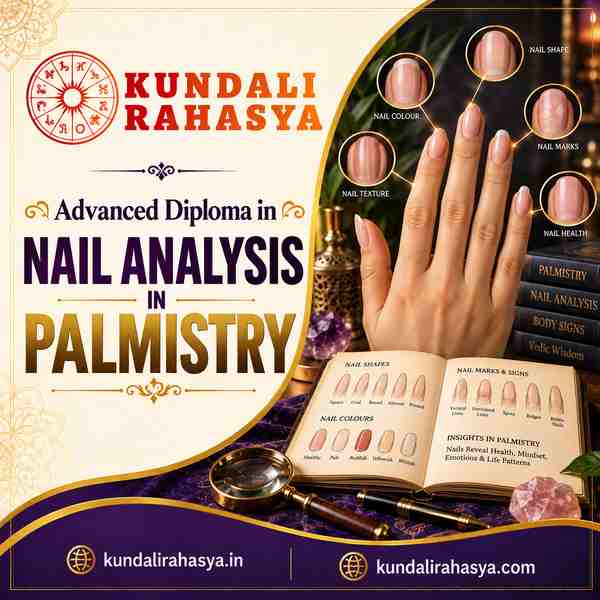
Develop an advanced understanding of traditional palmistry approaches related to nail shape, nail structure, nail length, nail width, nail proportions, nail texture, nail flexibility, nail curvature, nail colour, nail surface characteristics, nail markings, fingertips, finger formation, and other nail-related features with the Advanced Diploma in Nail Analysis in Palmistry. This specialized online program focuses on systematic study of fingernails as an important component of traditional hand analysis. Learners explore traditional methods of observing nail characteristics, comparing nails across different fingers and both hands, connecting nail observations with fingers, thumb, mounts, palm structure, lines, markings, and broader hand patterns, and developing structured nail-analysis interpretations.
Course Details
Course Name: Advanced Diploma in Nail Analysis in Palmistry
Course Code: ADNAP/PALM/A26
Course Level: Advanced Diploma
Eligibility: 12th Pass or Equivalent
Duration: 6 Months
Learning Mode: Online / Self-Paced / Recorded Lectures
Examination Mode: Online MCQ Examination
Certificate Validity: Lifetime
Certificate Verification: Online Verification Facility
About the Course
The Advanced Diploma in Nail Analysis in Palmistry is a specialized program focused on traditional palmistry interpretations associated with fingernails and their relationship with broader hand characteristics. The course provides a structured approach to studying nail shape, size, proportions, texture, flexibility, curvature, colour, surface features, markings, and other visible characteristics traditionally considered during hand analysis.
The program develops systematic nail observation skills by examining the nails in relation to the fingers, fingertips, thumb, palm structure, hand shape, mounts, major lines, minor lines, markings, signs, and overall hand patterns.
Learners explore traditional interpretations of different nail forms, including nail length, width, thickness, shape, proportion, curvature, flexibility, firmness, texture, surface appearance, and other physical characteristics. The program emphasizes understanding nail features within the context of the complete hand rather than interpreting one characteristic in isolation.
Particular attention is given to traditional observations involving the nails associated with Jupiter, Saturn, Sun, Mercury, Venus, and other relevant fingers. Learners study how nail characteristics may traditionally be considered alongside finger length, finger formation, spacing, fingertip shape, thumb characteristics, and mount development.
The course also introduces traditional observations involving nail colour, ridges, lines, grooves, spots, markings, surface formations, irregularities, and other visible nail characteristics. These features are studied as traditional palmistry observations and are not presented as scientifically proven indicators or medical diagnostic methods.
Learners further explore traditional relationships between nail characteristics and personality, temperament, mental approach, emotional expression, communication, confidence, practical behaviour, creativity, discipline, adaptability, professional tendencies, relationships, and other life-area themes traditionally considered within palmistry.
Through practical exercises and case studies, learners develop the ability to observe nails systematically, compare nail characteristics across fingers and both hands, connect nail observations with other palm features, identify combinations and patterns, organize interpretation notes, prepare structured nail-analysis observations, and communicate traditional palmistry-based interpretations responsibly.
Course Objectives
After completing this program, learners should have a better understanding of:
Advanced Nail Analysis in Palmistry principles
Traditional nail-analysis fundamentals
Nail-analysis terminology
Systematic nail observation
Fingernail structure and characteristics
Nail shape analysis
Nail length and proportion analysis
Nail width analysis
Nail thickness analysis
Nail formation analysis
Nail curvature analysis
Nail flexibility analysis
Nail firmness analysis
Nail texture analysis
Nail surface observation
Nail colour observation
Nail-bed observation
Lunula observation
Nail-edge observation
Fingertip and nail relationship
Finger and nail proportions
Finger-specific nail interpretation
Jupiter finger nail analysis
Saturn finger nail analysis
Sun finger nail analysis
Mercury finger nail analysis
Venus-related nail observation
Thumb and nail relationship
Nail and finger formation
Nail and hand-shape relationship
Nail and palm-structure relationship
Nail and mount relationship
Nail and palm-line relationship
Nail markings and signs
Nail ridges
Nail lines
Nail grooves
Nail spots
Nail surface formations
Traditional nail signs
Nail pattern recognition
Comparative nail analysis
Both-hand nail comparison
Dominant and non-dominant hand analysis
Nail and finger combination analysis
Nail and mount combination analysis
Nail and line combination analysis
Nail and marking combination analysis
Personality-related nail interpretation
Character-related interpretation
Temperament interpretation
Mental approach interpretation
Emotional interpretation
Communication-related interpretation
Confidence-related interpretation
Practical behaviour interpretation
Decision-making tendencies
Planning and organization tendencies
Discipline-related interpretation
Patience and persistence interpretation
Adaptability and flexibility
Creative and analytical tendencies
Professional tendency interpretation
Career-related interpretation
Business-related interpretation
Relationship-related interpretation
Marriage-related interpretation
Family-related interpretation
Talent and ability interpretation
Personal development interpretation
Life-area analysis
Palm pattern recognition
Comparative hand analysis
Traditional predictive palmistry approaches
Timing-related palmistry considerations
Practical nail reading
Nail-analysis interpretation synthesis
Structured nail observation
Nail-analysis report preparation
Case-study analysis
Responsible nail-analysis communication
Practical application of traditional nail-analysis principles
Who Should Enroll?
This program may be suitable for:
Students interested in specialized Nail Analysis in Palmistry
Palmistry learners seeking advanced nail and hand-analysis skills
Individuals interested in traditional fingernail interpretation
Palmistry enthusiasts studying detailed hand characteristics
Learners interested in nail shape and structure interpretation
Individuals exploring traditional nail-reading methods
Students interested in finger-specific nail analysis
Learners seeking deeper knowledge of nail characteristics and markings
Individuals interested in comparative nail and hand analysis
Palm readers wanting to develop structured nail-reading methods
Students interested in traditional predictive palmistry
Individuals interested in nail, finger, and palm combinations
Learners seeking practical nail-analysis case-study experience
Palmistry practitioners wishing to expand into specialized nail interpretation
Students planning further advanced studies in specialized palmistry systems
Basic familiarity with palmistry may be helpful because this is an advanced specialized program, particularly for learners who want to progress into detailed nail and hand-focused interpretation.
Key Skills You Will Develop
Nail Analysis Fundamentals
Develop a comprehensive understanding of traditional nail-analysis principles, nail structure, nail shapes, proportions, texture, flexibility, curvature, colour observations, markings, finger relationships, comparative analysis, interpretation, and responsible nail-reading practices.
Nail Observation
Develop a systematic approach to observing fingernails and identifying physical characteristics traditionally considered during palmistry-based hand analysis.
Nail Shape Analysis
Study different nail shapes and understand their traditional characteristics and interpretive significance within nail analysis.
Nail Length and Proportion Analysis
Examine nail length, width, proportions, symmetry, and formation as components of traditional nail interpretation.
Nail Texture Analysis
Understand how nail texture, smoothness, roughness, firmness, softness, thickness, and related characteristics may traditionally be considered during nail analysis.
Nail Flexibility Analysis
Explore traditional observations relating to nail flexibility, firmness, resilience, and formation and understand their place within broader nail interpretation.
Nail Curvature Analysis
Study traditional observations involving curved, flat, rounded, raised, and other nail formations.
Nail-Bed Observation
Understand traditional observations involving the nail bed, proportions, visible structure, and overall formation.
Lunula Observation
Study the traditional observation of the lunula and understand its place within broader nail and hand analysis.
Nail-Edge Observation
Examine the visible edges and formation of the nails as part of systematic traditional nail observation.
Finger-Specific Nail Analysis
Study the nails associated with different fingers and understand their traditional relationships with authority, discipline, creativity, communication, practical expression, and other characteristics.
Jupiter Finger Nail Analysis
Explore traditional observations associated with the Jupiter finger nail and its relationship with ambition, confidence, leadership, authority, and personal expression.
Saturn Finger Nail Analysis
Study traditional observations associated with the Saturn finger nail and its relationship with discipline, responsibility, seriousness, patience, and structured behaviour.
Sun Finger Nail Analysis
Understand traditional considerations involving the Sun finger nail and its association with creativity, recognition, confidence, expression, appreciation, and visibility.
Mercury Finger Nail Analysis
Explore traditional considerations involving the Mercury finger nail and its association with communication, adaptability, practical interaction, business ability, and networking.
Thumb and Nail Analysis
Study the relationship between thumb structure and thumb-nail characteristics within traditional hand analysis.
Nail Colour Observation
Explore traditional approaches to observing nail colour and visible variations as one component of broader palmistry-based interpretation.
Nail Surface Analysis
Learn to observe surface characteristics such as smoothness, ridges, lines, grooves, spots, markings, patterns, and other visible formations.
Nail Marking Identification
Develop the ability to identify traditionally observed nail marks, spots, lines, ridges, grooves, colour variations, and other formations.
Nail and Finger Relationship
Examine nail characteristics alongside finger length, shape, spacing, flexibility, proportions, fingertips, and overall finger formation.
Nail and Mount Relationship
Explore how nail observations may traditionally be considered alongside the Mounts of Jupiter, Saturn, Sun, Mercury, Venus, Moon, and Mars.
Nail and Palm Structure Analysis
Study nail characteristics as one component of complete hand observation and broader palmistry interpretation.
Nail and Hand-Shape Analysis
Understand how nail observations can be incorporated into traditional interpretations involving different hand shapes and elemental hand classifications.
Personality Interpretation
Explore traditional palmistry considerations connecting nail characteristics with temperament, behavioural tendencies, confidence, sensitivity, practicality, and personal expression.
Character Interpretation
Study traditional observations associated with character, discipline, confidence, adaptability, persistence, and behavioural expression.
Mental Approach Interpretation
Understand traditional interpretations involving reasoning, concentration, planning, practical thinking, imagination, and analytical tendencies.
Emotional Interpretation
Explore traditional nail-reading concepts related to emotional expression, sensitivity, composure, responsiveness, and interpersonal tendencies.
Communication Interpretation
Study traditional associations between nail characteristics and communication, expression, social interaction, adaptability, and practical interaction.
Behavioural Pattern Analysis
Learn to organize multiple nail observations into broader traditional interpretations of behaviour and temperament.
Career-Related Interpretation
Explore traditional observations that may be considered in relation to professional behaviour, discipline, communication, responsibility, practical abilities, and workplace tendencies.
Relationship Interpretation
Study traditional approaches to considering nail characteristics alongside broader hand features when discussing emotional and interpersonal tendencies.
Talent and Ability Interpretation
Explore traditional nail and hand observations associated with creativity, communication, practical ability, confidence, adaptability, and individual talents.
Nail Combination Analysis
Develop the ability to study multiple nail characteristics together rather than relying on a single feature.
Nail and Line Combination Analysis
Explore how nail observations may be considered together with major and minor palm lines for broader traditional interpretation.
Nail and Marking Combination Analysis
Study combinations involving nails, fingers, mounts, palm markings, signs, and other visible hand characteristics.
Comparative Nail Analysis
Compare nail characteristics across different fingers to identify similarities, differences, proportions, and traditionally interpreted patterns.
Both-Hand Nail Comparison
Compare dominant and non-dominant hands to observe traditional differences, developed characteristics, and broader hand patterns.
Palm Pattern Recognition
Recognize combinations of nail shapes, textures, markings, fingers, mounts, lines, and other palm features that may contribute to broader interpretations.
Traditional Predictive Palmistry
Study traditional predictive and timing-related palmistry concepts while understanding that these methods cannot scientifically guarantee particular events or outcomes.
Case-Study Interpretation
Apply nail-analysis concepts to practical examples involving different nail formations, finger structures, hand characteristics, combinations, and traditional interpretive patterns.
Nail-Analysis Report Preparation
Learn to organize nail and hand observations into structured palm-reading notes and present traditional interpretations clearly.
Responsible Nail Communication
Understand the importance of presenting nail-analysis observations as traditional interpretations rather than medical diagnoses, scientific conclusions, or guaranteed predictions.
Practical Application of Nail Analysis
Develop practical skills for applying traditional nail-analysis principles to hand examples, comparative observations, nail-feature exercises, combination analysis, case studies, and structured palm-reading interpretation.
Advanced Diploma in Nail Analysis in Palmistry Syllabus
Module 1: Foundations of Nail Analysis, Nail Structure and Traditional Observation
Introduction to specialized Nail Analysis in Palmistry, traditional palmistry terminology, systematic hand observation, fingernail structure, nail shape, length, width, proportions, thickness, texture, flexibility, curvature, nail bed, lunula, nail edges, surface appearance, fingertips, and the framework used for beginning a detailed nail-focused palm analysis.
Module 2: Nail Shapes, Fingers, Thumb and Structural Characteristics
Detailed study of nail length, width, shape, proportions, formation, curvature, flexibility, thickness, firmness, texture, fingertips, fingers, and thumb. Explore the traditional significance of nails associated with Jupiter, Saturn, Sun, Mercury, Venus, and other relevant hand areas, with emphasis on confidence, discipline, creativity, communication, authority, adaptability, practical expression, and behavioural characteristics.
Module 3: Nail Surface Features, Colour, Markings and Traditional Signs
Study nail surface appearance, colour observations, ridges, lines, grooves, spots, visible patterns, irregular formations, nail edges, lunula, nail-bed characteristics, and other traditionally observed features. Examine their traditional meanings according to appearance, finger, clarity, location, combinations, and relationship with surrounding hand features.
Module 4: Nail Combinations, Finger Relationships and Comparative Hand Analysis
Study traditional nail combinations involving shape, size, texture, flexibility, colour, markings, finger structure, thumb characteristics, mounts, palm shape, major lines, minor lines, and other hand features. Learn how multiple observations may be combined to form broader traditional interpretations and compare nail characteristics across both hands.
Module 5: Personality, Behaviour, Communication and Life-Area Interpretation
Explore traditional palmistry considerations related to personality, character, temperament, mental approach, emotional expression, communication, confidence, patience, persistence, discipline, adaptability, creativity, analytical thinking, practical behaviour, professional tendencies, relationships, family themes, talents, and personal development. Include dominant and non-dominant hand comparison and comparative nail analysis.
Module 6: Practical Nail Reading, Case Studies and Interpretation Synthesis
Apply specialized Nail Analysis in Palmistry principles through complete hand observation, nail-shape assessment, nail-structure analysis, finger comparison, thumb and nail assessment, surface-feature identification, traditional marking recognition, nail-and-palm combination analysis, both-hand comparison, practical examples, case studies, traditional predictive approaches, interpretation synthesis, structured observations, palmistry report preparation, and responsible presentation of traditional nail-analysis observations.
Admission, Learning, Examination and Certification Process
Step 1: Course Enrollment
Complete the online admission process for the Advanced Diploma in Nail Analysis in Palmistry and provide the required learner information.
Step 2: Learning Access
After enrollment, learners receive access to the online learning environment and available recorded course materials.
Step 3: Self-Paced Study
Study the program modules according to your preferred schedule. Learners can review recorded lectures and course material during the available learning period.
Step 4: Specialized Practical Learning
Apply nail-analysis concepts through nail observation, nail-shape analysis, nail-structure study, finger-specific analysis, thumb and nail assessment, surface-feature identification, marking identification, both-hand comparison, combination analysis, practical examples, and case studies.
Step 5: Course Completion
Complete the prescribed learning material and prepare for the online assessment after studying the program modules.
Step 6: Online Examination
Appear for the online MCQ examination according to the applicable examination process.
Step 7: Evaluation
The submitted examination is evaluated according to the prescribed assessment criteria.
Step 8: Certificate Issuance
Eligible learners who successfully complete the program and assessment requirements receive the Advanced Diploma in Nail Analysis in Palmistry.
Step 9: Certificate Verification
The certificate can be checked through the available online certificate verification facility.
Certificate Delivery
Digital certificate may be provided through the applicable online delivery process.
Certificate details can be used for online verification where the verification facility is available.
Certificate validity is lifetime.
Learners should retain their certificate details for future verification or educational documentation.
Career Opportunities
The knowledge developed through this program may support further learning and development in areas such as:
Nail Analysis Palmistry Practitioner
Palmistry Practitioner
Nail Reading Practitioner
Hand Analysis Practitioner
Palmistry Consultant
Specialized Palmistry Consultant
Palmistry Trainee
Palmistry Content Writer
Palmistry Content Developer
Hand Analysis Trainer
Palmistry Educator
Palmistry Course Mentor
Palm Reading Workshop Facilitator
Traditional Divination Practitioner
Online Palmistry Consultant
Palmistry Researcher
Palmistry Case Study Assistant
Independent Palmistry Practitioner
Traditional Hand Study Practitioner
Palmistry Learning Assistant
The program is designed to develop specialized knowledge and practical exposure in traditional nail and hand analysis. Learners interested in professional palm reading or consultation may continue with additional specialized education, practical training, hand-analysis experience, case-study practice, client communication skills, consultation practice, and advanced palmistry programs.
Scope for Independent Practice
Learners may explore specialized educational and practical activities involving:
Nail Analysis Study
Advanced Nail Analysis Study
Fingernail Structure Study
Nail Shape Study
Nail Length and Proportion Study
Nail Width Study
Nail Thickness Study
Nail Formation Study
Nail Curvature Study
Nail Flexibility Study
Nail Texture Study
Nail Colour Observation
Nail Surface Study
Nail-Bed Study
Lunula Observation Study
Nail-Edge Study
Fingertip and Nail Study
Finger and Nail Relationship Study
Thumb and Nail Study
Jupiter Finger Nail Study
Saturn Finger Nail Study
Sun Finger Nail Study
Mercury Finger Nail Study
Nail Marking Study
Nail Ridge Study
Nail Line Study
Nail Groove Study
Nail Spot Study
Nail Pattern Recognition
Nail and Mount Study
Nail and Palm Structure Study
Nail and Palm Line Study
Nail and Hand-Shape Study
Both-Hand Nail Comparison
Dominant and Non-Dominant Hand Study
Comparative Nail Analysis
Personality Interpretation Study
Character Interpretation Study
Temperament Interpretation Study
Mental Approach Interpretation Study
Emotional Interpretation Study
Communication-Related Interpretation Study
Career-Related Interpretation Study
Relationship Interpretation Study
Family-Related Interpretation Study
Talent and Ability Interpretation Study
Personal Development Study
Life-Area Analysis
Nail Combination Analysis
Finger and Nail Combination Study
Nail and Line Combination Study
Nail and Marking Combination Study
Traditional Predictive Palmistry Study
Timing-Related Palmistry Study
Practical Nail Reading
Nail-Analysis Interpretation
Practical Hand Analysis
Advanced Nail Observation and Synthesis
Responsible Nail Interpretation
Practical Palmistry Study
Nail-Analysis Exercises
Finger and Nail Analysis Exercises
Thumb and Nail Analysis Exercises
Nail Surface Observation Exercises
Nail Marking Identification Exercises
Comparative Nail Case Studies
Personality Case-Study Analysis
Career Case-Study Analysis
Relationship Case-Study Analysis
Practical Nail-Reading Exercises
Palmistry Research
Further Advanced Palmistry Education
The program provides educational knowledge and practical specialized exposure to traditional nail-analysis principles, fingernail structure, nail shapes, proportions, texture, flexibility, curvature, colour observations, nail markings, finger relationships, thumb characteristics, mounts, palm lines, hand shapes, both-hand comparison, personality and life-area themes, practical nail-reading methods, comparative analysis, case studies, and traditional palmistry interpretation. Nail Analysis in Palmistry is belief-based and should not be understood as a scientifically proven method for determining specific personal, health, professional, financial, relationship, or future outcomes. Nail observations should not be used as a substitute for qualified medical, psychological, financial, career, legal, relationship, or other professional advice.
Disclaimer
Nail Analysis in Palmistry is a traditional and belief-based practice. Nail interpretations taught in this program represent traditional interpretive concepts and should not be understood as scientifically proven methods for determining personality, health conditions, character, career suitability, professional success, relationships, or future events.
The course does not provide medical diagnosis or treatment and does not guarantee health, personality, career, financial, relationship, professional, educational, or any other particular outcome.
Changes in nail colour, texture, thickness, shape, ridges, grooves, spots, or other physical characteristics may have medical, nutritional, environmental, cosmetic, or other causes. Such observations should not be interpreted as medical conclusions through palmistry. Where appropriate, individuals should consult qualified healthcare professionals for health-related concerns.
Palmistry-based nail observations should not be used as a substitute for qualified medical advice, psychological support, career counselling, educational guidance, financial advice, legal advice, relationship counselling, or other professional services where appropriate.
Frequently Asked Questions
What is the Advanced Diploma in Nail Analysis in Palmistry?
The Advanced Diploma in Nail Analysis in Palmistry is a specialized online program focused on traditional interpretations of fingernail characteristics, nail shape, structure, proportions, texture, flexibility, curvature, colour observations, markings, finger relationships, comparative analysis, and broader hand-analysis principles.
How long is the program?
The program duration is 6 months. Learners can study through the available online, self-paced, and recorded learning format.
Who can enroll in this program?
The basic eligibility requirement is 12th Pass or Equivalent. The program is suitable for learners who want to develop specialized knowledge of traditional nail and hand analysis.
Do I need previous palmistry knowledge?
Basic familiarity with palmistry may be helpful because this is an advanced specialized program. Foundational concepts are also incorporated into the structured learning framework.
Is this program available online?
Yes. The program follows an online learning format with self-paced study and recorded lectures.
What is Nail Analysis in Palmistry?
Nail Analysis in Palmistry refers to the traditional practice of studying fingernail characteristics such as shape, length, width, texture, flexibility, curvature, colour, markings, and other visible features for interpretive purposes within broader hand analysis.
What are the major features studied in Nail Analysis?
Major features include nail shape, length, width, thickness, proportions, texture, flexibility, curvature, nail bed, lunula, colour observations, surface characteristics, markings, finger relationships, thumb characteristics, and combinations with other hand features.
Does the program cover different nail shapes?
Yes. The program introduces different nail shapes and traditional nail classifications and explains their relevance to practical nail-analysis interpretation.
Does the program cover nail length and proportions?
Yes. Nail length, width, proportions, symmetry, and formation are included as important components of systematic traditional nail observation.
Does the program cover nail texture?
Yes. Learners study traditional observations involving smoothness, roughness, firmness, softness, thickness, flexibility, and other nail-texture characteristics.
Does the program cover nail curvature?
Yes. The program introduces traditional observations involving curved, flat, rounded, raised, and other nail formations.
Does the program cover the lunula?
Yes. The lunula is included as one component of traditional nail observation and is studied alongside overall nail structure and other hand characteristics.
Does the program cover nail markings?
Yes. The program introduces traditional observations involving ridges, lines, grooves, spots, surface formations, colour variations, and other visible nail characteristics.
Does the program cover individual fingers?
Yes. Nail characteristics associated with different fingers are studied and considered alongside traditional finger interpretations.
Does the program cover the thumb?
Yes. The program covers the relationship between thumb characteristics and thumb-nail observations within traditional hand analysis.
Does the program cover palm mounts?
Yes. Learners explore how nail characteristics may traditionally be considered alongside the major mounts, including Jupiter, Saturn, Sun, Mercury, Venus, Moon, and Mars.
Does the program cover palm lines?
Yes. Nail observations may be considered alongside major and minor palm lines as part of broader traditional hand interpretation.
Does the program cover both hands?
Yes. The program introduces comparative analysis of both hands and traditional approaches to considering dominant and non-dominant hand characteristics.
Does the program cover personality interpretation?
Yes. The program introduces traditional considerations involving temperament, character, confidence, communication, emotional expression, practical behaviour, adaptability, and personal development.
Does the program cover career-related interpretation?
Yes. The program introduces traditional considerations involving professional behaviour, discipline, communication, practical abilities, responsibility, and workplace tendencies.
Does the program cover relationship interpretation?
Yes. Traditional considerations involving emotional expression, interpersonal tendencies, relationships, communication, and broader relationship themes are included.
Does the program teach health diagnosis through nails?
No. The program focuses on traditional palmistry-based nail interpretation and does not teach scientifically established medical diagnosis. Nail changes or health concerns should be evaluated by qualified healthcare professionals.
Can nail characteristics be interpreted independently?
The program emphasizes studying nails as one component of the complete hand. Nail characteristics may be considered together with fingers, thumb, mounts, palm structure, lines, markings, hand shape, and other features rather than treated as isolated guaranteed indicators.
Does the program teach predictive palmistry?
The program introduces traditional predictive and timing-related palmistry concepts as belief-based methods. These should not be treated as scientifically proven guarantees of future events or personal outcomes.
Can Nail Analysis in Palmistry guarantee a particular outcome?
No. Traditional nail analysis cannot scientifically guarantee personality traits, health conditions, career outcomes, relationship results, financial circumstances, or future events.
Does the course include practical case studies?
Yes. The program includes practical nail-observation activities and case studies involving different nail formations, finger structures, hand characteristics, combinations, and traditional interpretive patterns.
Will I learn comparative nail analysis?
Yes. Learners study methods of comparing nail characteristics across different fingers and both hands to identify similarities, differences, proportions, and broader traditional patterns.
Will I learn how to interpret a complete hand using nail observations?
The program introduces a structured approach to combining nail characteristics with hand shape, palm structure, fingers, thumb, mounts, major and minor lines, markings, and comparative observations. Broader palm-reading practice may require additional study and experience.
Can I become a professional nail-analysis practitioner after completing this program?
The program provides specialized educational knowledge and practical exposure and may serve as a starting point for further traditional palmistry practice. Professional practice generally requires additional specialized study, practical hand-analysis experience, case-study exposure, communication skills, consultation practice, and continued learning.
Does the program guarantee success in palmistry practice?
No. Completion of the program does not guarantee professional success, income, clients, consultations, readings, or any specific personal or professional outcome.
Can palmistry-based nail observations replace professional advice?
No. Palmistry-based nail observations should not replace qualified medical, psychological, financial, legal, career, relationship, or other professional advice when such advice is required.
Is the certificate valid for a lifetime?
Yes. The stated certificate validity for the program is Lifetime.
Can the certificate be verified online?
Yes. An Online Verification Facility is available for certificate verification as applicable.
What is the examination format?
The examination mode is an online MCQ examination according to the applicable examination process.
Can I study the program at my own pace?
Yes. The learning mode is Online / Self-Paced / Recorded Lectures, allowing learners to organize their study according to their available schedule.