
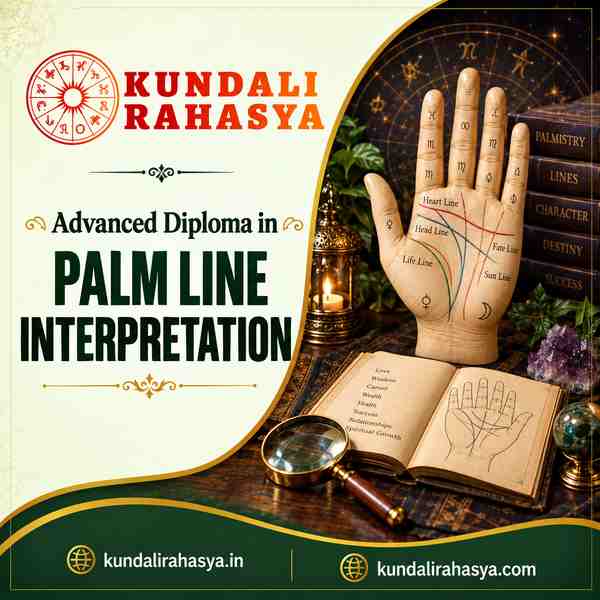
Description
Course Name: Advanced Diploma in Palm Line Interpretation
The Advanced Diploma in Palm Line Interpretation is designed for learners who want to understand the traditional principles of palm line analysis and develop systematic interpretation skills. The course covers major and minor palm lines, line formations, branches, breaks, intersections, line depth, continuity, and traditional interpretive techniques.
Through guided examples and practical hand-reading exercises, learners explore how palm line characteristics are traditionally interpreted in relation to personality, career, relationships, and personal development. The course is suitable for astrology students and practitioners who want to develop a structured approach to palm line interpretation.
Course Details
- Course Name: Advanced Diploma in Palm Line Interpretation
- Course Code: KR/ADP/PLI/031
- Course Level: Professional Diploma
- Eligibility: 10th Pass or Equivalent
- Duration: 6 Months
- Learning Mode: Online / Self-Paced / Recorded Lectures
- Examination Mode: Online MCQ Examination
- Certificate Validity: Lifetime
- Certificate Verification: Online Verification Facility
About the Advanced Diploma in Palm Line Interpretation Course
Palm line interpretation is a traditional palmistry practice that examines the lines, branches, breaks, intersections, depth, and continuity visible on the palm. Different palmistry traditions use their own approaches to interpreting these features and their symbolic associations.
This course introduces learners to systematic palm line observation and traditional interpretation principles. Learners study major palm lines, secondary lines, line formations, unusual markings, and variations in line structure. Practical examples demonstrate how multiple line characteristics can be examined together to develop structured interpretations rather than relying on a single line or presenting readings as guaranteed predictions.
Course Objective
The course aims to help learners understand traditional palm line interpretation principles and develop practical skills in identifying, comparing, and interpreting palm lines.
Learners will study:
Fundamentals of Palm Line Interpretation and traditional palmistry.
Identification of major palm lines and their characteristics.
Minor lines and their traditional significations.
Line depth, length, continuity, and direction.
Branches, breaks, forks, chains, and intersections.
Special markings and unusual line formations.
Traditional interpretation of career and relationship themes.
Comparative palm line analysis and practical case studies.
Responsible interpretation and ethical consultation.
Admission, Learning, Examination & Certification Process
Step 1: Select Your Course
Visit the Kundali Rahasya website and review the Advanced Diploma in Palm Line Interpretation course details.
Step 2: Complete Online Enrollment
Fill in the enrollment form with the requested personal and contact details.
Step 3: Make Secure Payment
Pay the course fee using one of the payment methods available during enrollment.
Step 4: Receive Learning Access
After enrollment is confirmed, follow the instructions provided to access the course materials.
Step 5: Study Online
Work through the available recorded lectures and learning materials at your own pace during the course period.
Step 6: Appear for the Online Examination
Complete the prescribed online MCQ examination according to the course requirements.
Step 7: Receive Your Certificate
Learners who complete the course and meet the assessment requirements may receive the diploma certificate.
Step 8: Online Certificate Verification
Use the available online verification facility, subject to the institution’s verification process.
Step 9: Career Guidance & Job Assistance
Learners may use any career guidance or job assistance made available by the institution. Employment, clients, or income are not guaranteed.
Who Should Enroll in the Advanced Diploma in Palm Line Interpretation?
This course may suit beginners, astrology students, palmistry learners, self-learners, and practicing consultants interested in traditional palm line analysis. It is particularly relevant for learners who want to develop their understanding of major and minor palm lines, line variations, special markings, and structured interpretation through a systematic learning approach.
Core Learning Areas
1. Fundamentals of Palm Line Interpretation
Understand the traditional background, terminology, basic principles, and methods of observing and recording palm line characteristics.
2. Major Palm Lines
Study the Life Line, Head Line, Heart Line, Fate Line, Sun Line, and Mercury Line, including their traditional interpretations and variations.
3. Minor Lines and Their Characteristics
Explore selected secondary lines, their locations, formations, and traditional significance within palmistry.
4. Line Variations and Formations
Examine line depth, length, continuity, direction, branches, breaks, forks, chains, intersections, and other visible variations.
5. Special Markings and Interpretation
Study crosses, stars, triangles, squares, islands, and other markings associated with palm lines while considering their positions and surrounding features.
6. Practical Palm Line Analysis
Practise comparing line formations, documenting observations, combining multiple features, and preparing structured interpretations through guided examples.
Advanced Diploma in Palm Line Interpretation Syllabus
Module 1: Foundations of Palm Line Interpretation
Introduction to traditional palmistry, terminology, historical background, scope and limitations, palm observation methods, line identification, and systematic recording of palm characteristics.
Module 2: Major Palm Lines and Their Interpretations
Detailed study of the Life Line, Head Line, Heart Line, Fate Line, Sun Line, and Mercury Line. Examination of their paths, length, depth, continuity, direction, and traditional interpretive associations.
Module 3: Minor Lines and Secondary Formations
Study of selected secondary lines, including relationship lines and other commonly described palm lines. Examination of their positions, formations, branches, and traditional interpretations.
Module 4: Line Variations, Breaks, and Intersections
Analysis of line breaks, forks, chains, branches, islands, crossings, intersections, and changes in line depth or direction. Methods for examining these features in relation to the surrounding palm structure.
Module 5: Special Signs and Traditional Applications
Interpretation of selected palm markings, including crosses, stars, triangles, squares, and tridents. Traditional applications concerning personality, career tendencies, relationships, and personal development, with emphasis on contextual interpretation.
Module 6: Practical Palm Line Analysis and Case Studies
Guided exercises involving identification of major and minor lines, comparison of both hands, examination of line variations, combining multiple observations, documenting illustrative cases, preparing reports, client communication, and ethical boundaries.
Advanced Diploma in Palm Line Interpretation Assessment Framework
1. Palm Line Fundamentals
Assessment of the learner’s understanding of traditional palmistry principles, terminology, and line identification.
2. Major Palm Lines
Evaluation of knowledge of major palm lines, their locations, characteristics, and traditional interpretations.
3. Minor Lines and Secondary Formations
Assessment of understanding of secondary lines, their formations, and their traditional significance.
4. Line Variations and Special Markings
Evaluation of the ability to identify branches, breaks, forks, intersections, and selected markings.
5. Traditional Interpretation
Assessment of introductory knowledge of contextual palm line interpretation and the comparison of multiple features.
6. Practical Palm Line Analysis
Evaluation of the ability to organise observations and explain a sample palm line reading in a structured manner.
7. Online MCQ Examination
Completion of the prescribed multiple-choice examination according to the course requirements.
Certification Process
Learners who complete the course and meet the prescribed assessment criteria may receive the Advanced Diploma in Palm Line Interpretation. Certificate issuance and verification follow the institution’s applicable procedures.
Career Opportunities
Palm Line Interpretation Consultation: Learners may continue developing their skills and, with sufficient study and experience, explore consultations based on traditional palm line interpretation.
Astrology Education and Content Creation: Graduates may prepare educational articles, learning resources, and explanatory content about palm lines and traditional palmistry principles.
Further Specialized Study: The course can support continued learning in palmistry, Hasta Rekha Shastra, Samudrika Shastra, and related interpretative practices.
Scope for Independent Palm Line Interpretation Practice
Practitioners may gradually develop services involving:
Identification and interpretation of major palm lines.
Study of minor lines and secondary formations.
Analysis of line branches, breaks, forks, and intersections.
Interpretation of special palm markings.
Structured palm line consultations.
Preparation of palm line interpretation reports.
Educational content about traditional palmistry.
Independent practice requires continued study, practical experience, and clear communication. Palm line interpretation should not be presented as a scientifically established method of predicting outcomes or diagnosing medical conditions. Interpretations should not replace qualified medical, legal, financial, or other professional advice.
Expected Income & Earning Potential
Income varies with experience, service quality, demand, pricing, and the ability to build a client base. Completing a diploma does not guarantee employment or earnings.
Indicative ranges:
- Beginner / Entry-Level: ₹2,50,000–₹5,00,000 per year
- Experienced Consultant: ₹5,00,000–₹10,00,000 per year
- Independent Practitioner: ₹7,00,000–₹15,00,000+ per year
- Established Professional: ₹12,00,000–₹20,00,000+ per year
These figures are illustrative, not verified salary data or guaranteed outcomes. Actual earnings may be lower or higher.
Why Choose an Advanced Diploma in Palm Line Interpretation?
The course focuses on traditional palm line interpretation techniques, including major and minor lines, line formations, branches, breaks, intersections, and special markings. Its six-month format provides a structured learning period for studying these concepts and practising systematic palm line observation through guided examples.
The structured approach encourages learners to examine multiple line characteristics together and prepare balanced interpretations. Continued study and practical experience remain important for anyone considering professional palm line interpretation.
What is an Advanced Diploma in Palm Line Interpretation?
It is a diploma course covering traditional palm line interpretation, including major and minor lines, line variations, special markings, and practical reading techniques.
Can I learn Palm Line Interpretation online?
Yes. The course is designed for online, self-paced learning through the available recorded lectures and learning materials.
What practical skills will I develop?
You will practise identifying major and minor lines, examining line formations, recognising variations and markings, and preparing structured interpretations.
What is the eligibility?
The eligibility requirement is 10th Pass or Equivalent.
Is the examination conducted online?
Yes. The prescribed assessment mode is an online MCQ examination.
Can I become a Palm Line Interpretation Consultant after completing this course?
The course can provide a foundation for further practice. Professional competence requires continued study, practical experience, and responsible communication. Employment, clients, and income are not guaranteed.
Is the diploma verifiable online?
An online certificate verification facility is listed, subject to the institution’s verification process.
Who can join this course?
Beginners, astrology students, palmistry learners, self-learners, and practicing consultants may enroll if they meet the stated eligibility requirements.
