
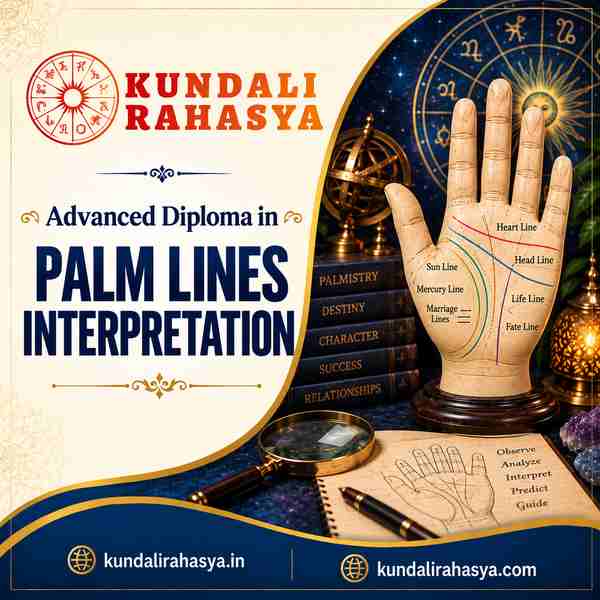
Description
Course Name: Advanced Diploma in Palm Lines Interpretation
Palm Lines Interpretation focuses on identifying principal and secondary palm lines and studying the meanings traditionally associated with their placement, shape, depth, branches, and variations. The Advanced Diploma in Palm Lines Interpretation develops learners’ ability to observe line patterns methodically and organise observations into structured traditional readings.
The program covers the Life Line, Head Line, Heart Line, Fate Line, Sun Line, minor lines, intersections, breaks, branches, chains, and other visible markings. Learners practise comparing line features across both hands, recording observations, and considering several features together rather than relying on a single sign.
The course addresses consultation skills, confidentiality, and professional ethics. Palmistry is not scientifically established as a reliable way to predict future events or determine personality, health, or life outcomes; line interpretations are presented as traditional perspectives rather than proven assessments.
Course Details
- Course Name: Advanced Diploma in Palm Lines Interpretation
- Course Code: KR/AD/PLI2521
- Course Level: Advanced Diploma
- Eligibility: 10th Pass or Equivalent
- Duration: 6 Months
- Learning Mode: Online / Self-Paced / Recorded Learning Resources
- Examination Mode: Online MCQ Examination
- Certificate Validity: Lifetime
- Certificate Verification: Online Verification Facility
About the Advanced Diploma in Palm Lines Interpretation Course
The Advanced Diploma in Palm Lines Interpretation offers structured study of traditional palmistry with a particular focus on principal lines and variations commonly discussed in hand-reading systems.
Learners examine the Life Line, Head Line, Heart Line, Fate Line, Sun Line, and other minor lines. They explore placement, length, depth, continuity, curves, branches, breaks, chains, intersections, and related markings while documenting visible features separately from traditional meanings.
Case-based exercises introduce comparison of both hands, integrated line analysis, organised reading notes, consultation communication, confidentiality, and responsible presentation of interpretations.
Course Objective
The objective of this Advanced Diploma is to develop learners’ skills in identifying, documenting, and interpreting palm lines within traditional palmistry, alongside responsible reading and consultation practices.
Learners will study:
Foundations of palm line interpretation
Principal palm lines and their traditional associations
Life Line identification and variations
Head Line identification and variations
Heart Line identification and variations
Fate Line identification and variations
Sun Line and commonly discussed minor lines
Line placement, length, depth, and continuity
Branches, breaks, chains, islands, and intersections
Comparing line features on both hands
Combining several lines in an integrated reading
Separating visible observations from interpretations
Structured case records and reading notes
Practical palm line case studies
Consultation and client communication
Confidentiality and professional ethics
Admission, Learning, Examination & Certification Process
Step 1 – Select Your Course: Choose the Advanced Diploma in Palm Lines Interpretation from the available course catalogue.
Step 2 – Complete Online Enrollment: Submit the required information through the online enrollment process.
Step 3 – Make Secure Payment: Pay the applicable course and examination fee through the available payment options.
Step 4 – Receive Learning Access: Study access and login details will be provided to the registered email address after enrollment processing.
Step 5 – Study Online: Access the available study materials and recorded learning resources during the prescribed course duration.
Step 6 – Appear for the Online Examination: Complete the online MCQ examination after finishing the required learning activities.
Step 7 – Receive Your Certificate: Candidates who successfully complete the applicable course and examination requirements receive their certificate according to the provider’s process.
Step 8 – Online Certificate Verification: The authenticity of an issued certificate can be checked through the available online verification facility.
Step 9 – Career Guidance & Job Assistance: Eligible certified candidates may receive career guidance and information about suitable opportunities. Job assistance does not guarantee employment.
Who Should Enroll in the Advanced Diploma in Palm Lines Interpretation Course?
This online diploma may suit Palmistry Learners, Aspiring Palm Readers, Traditional Knowledge Students, Astrology Learners, Numerologists, Researchers, Independent Consultants, Freelancers, and Working Professionals interested in a focused study of palm lines.
Careful observation, organised note-taking, and regular practice are helpful. Learners should distinguish visible line features from traditional interpretations, recognise that systems may vary, and communicate limitations responsibly.
Core Learning Areas
Foundations of Palm Line Interpretation
Study palmistry terminology, traditional approaches to line reading, and an organised sequence for identifying and documenting palm lines before developing an interpretation.
Principal Palm Lines
Identify the Life Line, Head Line, Heart Line, and Fate Line. Study their positions, curves, length, depth, continuity, and commonly discussed variations.
Minor Lines & Markings
Explore the Sun Line and other commonly discussed minor lines. Observe branches, chains, islands, breaks, intersections, and related markings within traditional palmistry.
Line Patterns & Variations
Examine changes in line direction, clarity, continuity, branching, and intersections. Practise describing what is visible before considering traditional meanings.
Comparing Both Hands
Compare line placement and patterns across dominant and non-dominant hands, recording similarities and differences without treating them as conclusive evidence about a person.
Integrated Line Analysis
Combine observations from several principal and minor lines into a structured traditional reading. Acknowledge that interpretations can differ between palmistry approaches.
Practical Case Documentation
Practise recording line observations, separating description from interpretation, reviewing sample cases, and preparing organised reading notes.
Professional Consultation & Ethics
Develop skills in client communication, confidentiality, expectation-setting, and responsible explanation of traditional palm line interpretations.
Advanced Diploma in Palm Lines Interpretation Syllabus
Module 1: Foundations of Palm Line Interpretation
Review palmistry terminology, traditional line-reading approaches, observation methods, line identification, and consistent ways to document visible features.
Module 2: Principal Lines of the Palm
Study the Life Line, Head Line, Heart Line, and Fate Line, including their placement, length, depth, curves, continuity, and traditional associations.
Module 3: Line Variations & Patterns
Examine branches, breaks, chains, islands, intersections, changes in direction, and other commonly discussed variations in palm lines.
Module 4: Minor Lines & Additional Markings
Explore the Sun Line, other minor lines, and markings described in traditional palmistry. Practise recording visible characteristics and interpretive context.
Module 5: Integrated Line Reading & Case Records
Compare both hands, combine observations from multiple lines, review sample cases, maintain structured notes, and prepare balanced traditional readings.
Module 6: Consultation, Ethics & Final Assessment
Apply course concepts to practical exercises. Review consultation methods, confidentiality, professional boundaries, responsible communication, revision, and final assessment preparation.
Advanced Diploma in Palm Lines Interpretation Assessment Framework
Principal Line Identification
Assess the ability to locate and describe the Life Line, Head Line, Heart Line, and Fate Line.
Minor Line Awareness
Review familiarity with the Sun Line and other commonly discussed minor lines.
Line Feature Observation
Evaluate the ability to describe line placement, length, depth, curves, continuity, and visible variations consistently.
Pattern Recognition
Assess recognition and documentation of branches, breaks, chains, islands, intersections, and changes in line direction.
Comparative Line Analysis
Evaluate the ability to compare line features across both hands and record similarities and differences.
Observation Records
Assess whether learners distinguish visible line features from traditional interpretive statements.
Integrated Interpretation
Review the ability to combine observations from multiple lines into a coherent, appropriately qualified traditional reading.
Practical Exercises
Use sample hands and guided observations to assess consistency, line recognition, and application of course concepts.
Case Documentation
Assess the organisation of observation notes, case details, and interpretation summaries.
Consultation Skills
Review clarity, respectful communication, expectation-setting, and appropriate explanation of traditional methods.
Ethical Understanding
Assess awareness of confidentiality, professional boundaries, uncertainty, and avoidance of fear-based or unsupported claims.
Final Assessment
Evaluate overall learning through the prescribed online MCQ examination and applicable course completion requirements.
Certification Process
After successfully completing the applicable examination and course requirements, eligible candidates receive the Advanced Diploma in Palm Lines Interpretation certificate according to the course provider’s process. Issued certificates may be authenticated through the available online verification facility. Certificate validity is lifetime.
Career Opportunities
After completing the Advanced Diploma in Palm Lines Interpretation, learners may explore palmistry-related opportunities according to their practical competence, experience, communication skills, and continued professional development.
Potential areas include Palmistry Consultant, Palm Reader, Palm Line Interpretation Practitioner, Independent Palmistry Practitioner, Traditional Knowledge Educator, Workshop Facilitator, Freelance Consultant, and Palmistry Content Creator.
Palmistry should be described as a traditional interpretive practice, not a scientifically validated predictive method. Course completion does not guarantee employment, clients, or income.
Scope for Independent Palm Lines Interpretation Practice
Practitioners may develop services involving:
Structured palm line observation
Principal line identification
Life Line feature analysis
Head Line feature analysis
Heart Line feature analysis
Fate Line feature analysis
Minor line observation
Line pattern documentation
Branches and intersections recording
Comparison of both hands
Integrated traditional line readings
Case study preparation
Observation and interpretation reports
Introductory palmistry workshops
Educational palmistry content
Expected Income & Earning Potential
Earning potential varies according to experience, consultation format, specialization, client volume, reputation, fees, online presence, and work arrangement.
Indicative ranges:
- Beginner: ₹1,80,000 – ₹4,00,000 per year
- Experienced: ₹4,00,000 – ₹8,00,000 per year
- Independent Practitioner: ₹6,00,000 – ₹12,00,000+ per year
- Established Practitioner: ₹9,00,000 – ₹16,00,000+ per year
These figures are indicative planning ranges, not verified salary benchmarks or guaranteed income. Actual earnings may vary considerably.
Why Choose an Online Advanced Diploma in Palm Lines Interpretation?
A structured learning process can help learners identify line features consistently, organise notes, and separate visible characteristics from traditional interpretation. It encourages learners to consider line patterns together rather than rely on one marking.
The program progresses from principal lines to variations, minor lines, comparative analysis, case records, and consultation methods. Online learning resources support remote study and revision.
Palmistry remains a traditional interpretive practice rather than a scientifically validated predictive method. Continued practice, transparent communication, and realistic expectations are important.
What is an Advanced Diploma in Palm Lines Interpretation?
It is a structured course in traditional palmistry that covers principal and minor palm lines, line patterns, visible markings, comparative analysis, case documentation, and responsible interpretation.
Can I learn Palm Lines Interpretation online?
Yes. The program is offered through online learning resources, subject to the course provider’s access and study arrangements.
What practical skills will I develop?
Learners practise identifying palm lines, recording visible features, comparing both hands, examining line variations, and preparing structured traditional readings.
What is the eligibility?
The minimum eligibility is 10th Pass or Equivalent.
Is prior knowledge of palmistry required?
Basic familiarity may be helpful, but applicants should confirm any additional prerequisites with the course provider.
Is the examination conducted online?
The stated examination mode is an online MCQ examination, subject to the course provider’s applicable requirements.
What will I learn?
Learners study principal and minor lines, line placement and variations, branches, breaks, comparative analysis, case documentation, and consultation ethics.
Can I offer palm line reading consultations after completing this diploma?
The diploma may provide a foundation for further study or introductory practice. Professional consultation also requires continued learning, practical experience, and responsible communication.
Is the certificate verifiable online?
Issued certificates can be checked through the online verification facility, subject to the course provider’s verification process.
Who can join this course?
Palmistry learners, aspiring palm readers, traditional knowledge enthusiasts, Astrology and Numerology learners, researchers, freelancers, and interested working professionals may apply, subject to the eligibility requirements.
