
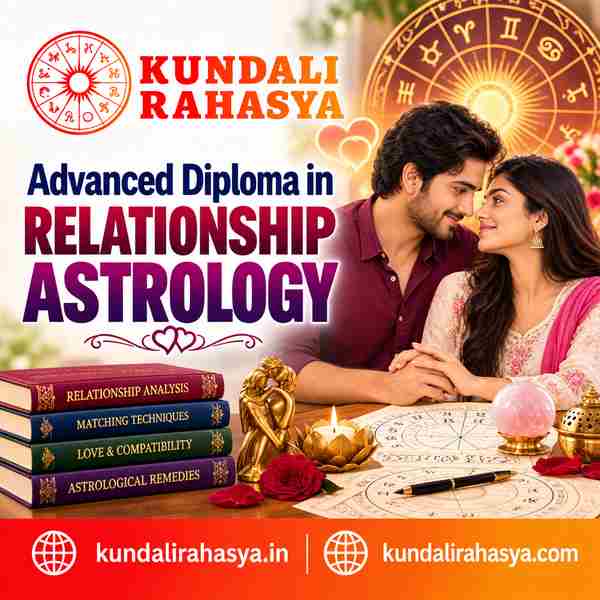
Description
Course Name: Advanced Diploma in Relationship Astrology
The Advanced Diploma in Relationship Astrology is a professional-level course designed to develop a systematic understanding of relationship-related horoscope interpretation in Vedic astrology. Learners explore the traditional significance of the seventh house, Venus, the Moon, planetary relationships, Navamsa placements, compatibility indicators, and other factors commonly considered when examining emotional connections, partnership dynamics, and relationship patterns.
The Advanced Diploma in Relationship Astrology provides structured learning through online study resources, recorded lectures, chart-based exercises, and illustrative case studies. The course introduces methods for examining relationship-related planetary placements, comparing horoscope factors, and considering traditional Dasha and transit influences within the broader birth chart. It emphasizes organized analysis and responsible communication rather than presenting astrological indications as certain outcomes.
Course Details
- Course Name: Advanced Diploma in Relationship Astrology
- Course Code: KR/AD/RA/065
- Course Level: Professional Diploma
- Eligibility: 10th Pass or Equivalent
- Duration: 6 Months
- Learning Mode: Online / Self-Paced / Recorded Lectures
- Examination Mode: Online MCQ Examination
- Certificate Validity: Lifetime
- Certificate Verification: Online Verification Facility
About the Advanced Diploma in Relationship Astrology Course
The course introduces learners to traditional methods used to examine relationship-related factors in a birth chart. It covers the seventh house, Venus, the Moon, relevant planetary combinations, house lordships, and the Navamsa chart. Learners study how planetary placements and relationships between chart factors are interpreted within the broader horoscope rather than treating an individual placement as a complete explanation of a person’s emotional or relationship circumstances.
The course also explores traditional compatibility concepts, relationship patterns, and timing indicators through planetary periods and transits. Through practical examples, learners practise identifying relevant factors, comparing supporting and modifying indications, documenting interpretive reasoning, and preparing structured reports. Relationship Astrology is presented as a traditional astrological discipline and does not guarantee compatibility, relationship success, reconciliation, marriage, or any particular outcome.
Course Objective
The objective of this Advanced Diploma is to develop a structured understanding of Relationship Astrology and introduce practical skills in evaluating relationship-related houses, planetary significations, compatibility factors, Navamsa placements, and traditional timing indicators.
Learners will study:
Foundations of Relationship Astrology in Vedic Jyotish
The seventh house and its traditional significance
Role of Venus, the Moon, and relevant planetary placements
House lordships and planetary relationships
Relationship-related planetary combinations and yogas
Navamsa chart interpretation for relationship analysis
Traditional horoscope compatibility concepts
Emotional and partnership indicators in horoscope interpretation
Dasha and transit factors in relationship timing analysis
Assessment of supporting and modifying chart indications
Comparative horoscope exercises and case studies
Interpretation notes and report preparation
Professional ethics and responsible communication
Admission, Learning, Examination & Certification Process
Step 1 – Select Your Course: Choose the Advanced Diploma in Relationship Astrology after reviewing the course details, learning objectives, and eligibility requirements.
Step 2 – Complete Online Enrollment: Submit the required information through the online enrollment process.
Step 3 – Make Secure Payment: Pay the applicable course and examination fee through the available payment options.
Step 4 – Receive Learning Access: Receive study access and login details at the registered email address after enrollment processing.
Step 5 – Study Online: Access recorded lectures and digital materials. Complete exercises on relationship-related houses, planetary combinations, compatibility indicators, Navamsa placements, and integrated chart interpretation.
Step 6 – Appear for the Online Examination: Complete the online MCQ examination after finishing the required learning.
Step 7 – Receive Your Certificate: Successful candidates receive a digital certificate by registered email and an original certificate according to the applicable dispatch process.
Step 8 – Online Certificate Verification: Verify the authenticity of the issued certificate through the online verification facility.
Step 9 – Career Guidance & Job Assistance: Eligible certified candidates may receive career guidance and information about relevant professional opportunities. Job assistance does not guarantee employment.
Who Should Enroll in the Advanced Diploma in Relationship Astrology?
This course may suit Vedic astrology enthusiasts, astrology students, aspiring astrologers, practising horoscope readers, and learners who want to improve their understanding of relationship-related horoscope interpretation. It may also benefit individuals seeking a structured method for examining partnership indicators, compatibility factors, planetary relationships, and traditional timing principles. Familiarity with planets, signs, houses, and basic horoscope interpretation is recommended.
Core Learning Areas
Foundations of Relationship Horoscope Analysis
Study the traditional principles and terminology used to examine relationship-related factors in a birth chart. Understand how houses, planetary significations, and chart relationships contribute to a structured interpretation.
Relationship-Related Houses and Planets
Explore the seventh house, its lord, Venus, the Moon, and other relevant planetary factors. Learn to examine their placements, relationships, and traditional significations within the broader horoscope.
Navamsa Chart and Partnership Interpretation
Study the traditional role of the Navamsa chart in relationship analysis. Examine relevant planetary placements and relationships between the birth chart and divisional chart.
Compatibility and Relationship Indicators
Explore traditional horoscope compatibility concepts, planetary combinations, and relationship-related yogas. Learn to compare several indicators without relying on a single placement to assess a relationship.
Relationship Timing and Integrated Assessment
Practise examining traditional Dasha and transit factors alongside relationship-related houses and planetary placements. Learn to identify supporting and modifying indications while communicating uncertainty appropriately.
Practical Analysis and Professional Ethics
Develop skills in horoscope comparison, case documentation, structured interpretation, report writing, confidentiality, and responsible communication about the limitations of astrological indications.
Advanced Diploma in Relationship Astrology Syllabus
Module 1: Foundations of Relationship Astrology
Study the meaning and scope of Relationship Astrology in traditional Vedic Jyotish. Explore relationship-related houses, planetary significations, and the importance of examining the complete horoscope before preparing an interpretation.
Module 2: Seventh House, Venus, and Planetary Relationships
Examine the seventh house, its lord, Venus, the Moon, and other relevant planetary factors. Study their sign placements, house positions, dignity, aspects, and relationships with other chart factors. Practise recording observations systematically.
Module 3: Navamsa Chart and Relationship Indicators
Explore the traditional role of the Navamsa chart in relationship-related interpretation. Examine relevant divisional placements and compare them with the birth chart within the framework of traditional astrology.
Module 4: Compatibility and Relationship Patterns
Study introductory concepts of traditional horoscope compatibility and selected relationship-related planetary combinations. Practise reviewing relevant factors and identifying supporting or modifying indications without treating any single combination as conclusive.
Module 5: Relationship Timing and Integrated Interpretation
Explore traditional methods of considering planetary periods and transits in relationship-related analysis. Compare relevant Dasha factors, house indicators, and planetary placements in sample charts while avoiding guaranteed predictions about relationship events.
Module 6: Practical Case Studies and Professional Ethics
Work through illustrative horoscope examples. Practise relationship-related chart assessment, compatibility-factor review, case documentation, interpretation summaries, report preparation, confidentiality, and responsible communication of uncertainty and limitations.
Relationship Astrology Assessment Framework
Birth Chart Review
Review the available birth details and chart structure, noting uncertainties that may affect chart calculation or interpretation.
Relationship House Assessment
Identify relevant houses, their lords, and planetary placements. Record the traditional factors considered in the relationship-related assessment.
Planetary Relationship Review
Examine Venus, the Moon, and other relevant planetary placements, considering their signs, houses, dignity, and relationships with partnership indicators.
Navamsa Chart Assessment
Review relevant Navamsa placements and compare them with the birth chart within the traditional framework used for the exercise.
Compatibility and Timing Context
Connect relationship-related observations with relevant compatibility factors, planetary periods, and transit considerations rather than drawing conclusions from a single placement.
Practical Case Documentation
Prepare organized notes describing the chart factors reviewed, interpretive reasoning, supporting or modifying indications, and limitations.
Report Preparation
Create a clear Relationship Astrology report that explains the traditional factors considered and presents interpretations without guaranteeing compatibility, relationship success, reconciliation, or specific outcomes.
Certification Process
After successfully completing the applicable online examination requirements, candidates receive a digital certificate by registered email and an original certificate according to the applicable dispatch process. Issued certificates can be verified through the online certificate verification facility. Certificate validity is lifetime, subject to the applicable issuance terms.
Career Opportunities
After completing the Advanced Diploma in Relationship Astrology, learners may explore astrology-related opportunities according to their knowledge, practical competence, experience, and client demand.
Potential areas include Relationship Astrology Consultation, Relationship Horoscope Interpretation, Traditional Compatibility Analysis, Seventh-House Assessment, Navamsa Chart Interpretation, Relationship Timing Discussions, Horoscope Report Preparation, Online Astrology Consultation, Astrology Content Creation, Educational Workshop Assistance, Traditional Astrology Research and Documentation, and Independent Relationship Astrology Practice.
The course does not guarantee employment, clients, or income. Professional development depends on continued study, practical experience, communication skills, and individual circumstances.
Scope for Independent Relationship Astrology Practice
Practitioners may gradually develop services involving:
Relationship-Related House Assessment
Planetary Placement Interpretation
Venus and Moon Placement Review
Navamsa Chart Analysis
Traditional Horoscope Compatibility Analysis
Relationship-Related Yoga Assessment
Partnership Indicator Review
Dasha-Based Relationship Timing Discussion
Transit-Based Timing Assessment
Comparative Horoscope Case Studies
Written Relationship Astrology Reports
Online Astrology Consultation
Educational Articles and Workshops
Traditional Astrology Research and Documentation
Practitioners should communicate the traditional nature and limitations of astrological interpretations. Relationship decisions should respect personal choice, consent, communication, and individual circumstances. Astrology should not be presented as a substitute for qualified medical, legal, financial, or other professional advice.
Expected Income & Earning Potential
Earning potential varies according to expertise, experience, specialization, client volume, consultation fees, professional reputation, location, and work arrangement.
Indicative ranges:
- Beginner / Entry-Level: ₹2,50,000–₹5,00,000 per year
- Experienced Consultant: ₹5,00,000–₹10,00,000 per year
- Independent Practitioner: ₹7,00,000–₹15,00,000+ per year
- Established Professional: ₹12,00,000–₹20,00,000+ per year
These figures are illustrative estimates only and are not guaranteed earnings. Actual income depends on individual circumstances, professional capabilities, and market demand.
Why Choose an Advanced Diploma in Relationship Astrology?
The Advanced Diploma in Relationship Astrology offers structured study of relationship-related houses, planetary significations, Navamsa interpretation, compatibility concepts, and traditional timing methods. Learners progress from foundational concepts to integrated horoscope assessment, practical exercises, case documentation, and report preparation.
The course emphasizes a methodical process: identify the relevant relationship indicators, examine the seventh house and its lord, review planetary placements and Navamsa factors, consider compatibility and timing indicators, and document the reasoning. Online, self-paced learning allows learners to study according to their schedules and build a foundation for further learning or astrology-related practice.
What is an Advanced Diploma in Relationship Astrology?
It is a professional diploma-level course introducing traditional methods for examining relationship-related houses, planetary combinations, Navamsa placements, compatibility factors, and timing indicators.
Can I learn Relationship Astrology online?
Yes. The course provides online learning through recorded lectures and digital study materials that learners can access at their own pace.
What practical skills will I develop?
Learners practise relationship-house assessment, planetary relationship review, Navamsa interpretation, compatibility-factor analysis, traditional timing assessment, case documentation, and report preparation.
What is the eligibility?
The minimum eligibility is 10th Pass or Equivalent. Familiarity with basic Vedic astrology concepts is recommended.
Is the examination conducted online?
Yes. The assessment is conducted through an online MCQ examination, subject to the applicable course requirements.
Can I become a Relationship Astrology Consultant after completing this course?
The course can provide a foundation for further study or astrology-related practice. Professional competence also requires continued learning, practical experience, responsible communication, and an understanding of professional boundaries. The course does not guarantee employment, clients, or professional success.
Is the certificate verifiable online?
Yes. Issued certificates can be checked through the online certificate verification facility.
Who can join this course?
Astrology students, Vedic astrology enthusiasts, aspiring astrologers, practising horoscope readers, and learners interested in traditional relationship horoscope interpretation may enroll, subject to the stated eligibility requirements.
