
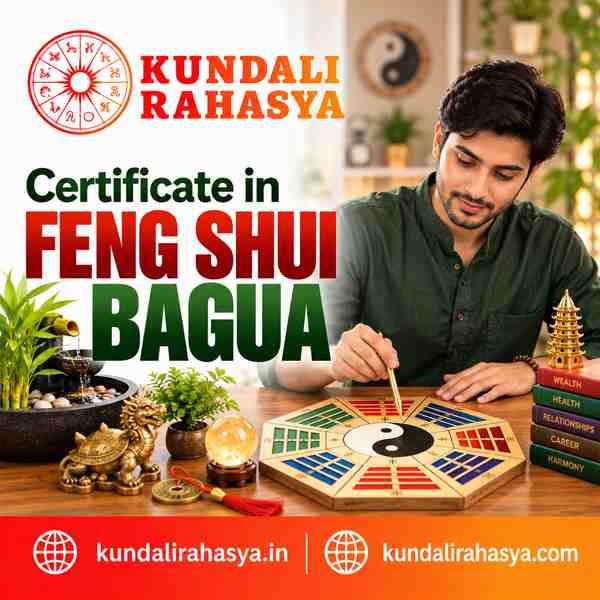
Description
Course Name: Certificate in Feng Shui Bagua
The Certificate in Feng Shui Bagua introduces the Bagua, a traditional Feng Shui framework for discussing areas of a space and their symbolic associations. Learners explore directions, entrances, room functions, and the Five Elements through simple floor-plan exercises.
Bagua interpretations vary between schools. This course presents them as traditional concepts, not guaranteed predictors. Practical safety, accessibility, and the needs of people using a space remain important.
Course Details
- Course Name: Certificate in Feng Shui Bagua
- Course Code: KR/C/FB2474
- Course Level: Professional Certificate
- Eligibility: 10th Pass or Equivalent
- Duration: 3 Months
- Learning Mode: Online / Self-Paced / Recorded Lectures
- Examination Mode: Online MCQ Examination
- Certificate Validity: Lifetime
- Certificate Verification: Online Verification Facility
About the Certificate in Feng Shui Bagua Course
This course introduces Bagua as used in traditional Feng Shui, including spatial areas, orientation, room functions, and symbolic themes. Learners practise reading simple plans, noting entrances and functional zones, and explaining which method they used. It provides foundational knowledge, not professional training in architecture, interior design, surveying, or building safety.
Course Objective
The objective is to develop foundational Bagua knowledge and practise structured layout review and responsible interpretation.
Learners will study:
Origins and introductory terminology of Feng Shui
The meaning and purpose of the Bagua framework
Common Bagua areas and traditional associations
Basic direction and orientation awareness
Reading simple floor plans
Identifying entrances and functional zones
Applying a stated Bagua approach to a sample layout
Differences between common Feng Shui schools
Introductory links between Bagua and the Five Elements
Room functions and movement pathways
Recording observations and interpretation notes
Comparing layout features with traditional associations
Preparing concise Bagua review summaries
Communicating the method used in a review
Recognising uncertainty and interpretive variation
Maintaining client privacy and professional boundaries
Avoiding absolute claims and unsupported guarantees
Referring technical questions to qualified professionals
Admission, Learning, Examination & Certification Process
Step 1 – Select Your Course: Review the course overview, eligibility, duration, learning outcomes, and syllabus before enrolling.
Step 2 – Complete Online Enrollment: Submit the required registration details through the official enrollment process.
Step 3 – Make Secure Payment: Pay the applicable course fee through the available payment facility and retain confirmation.
Step 4 – Receive Learning Access: After enrollment processing, access instructions and study materials are provided through the designated channel.
Step 5 – Study Online: Complete recorded lessons and practice activities at your own pace, revisiting topics when needed.
Step 6 – Appear for the Online Examination: Complete the online MCQ examination according to the course administrator’s instructions.
Step 7 – Receive Your Certificate: Eligible learners receive a digital certificate by registered email. The original certificate, where applicable, follows the organisation’s dispatch process.
Step 8 – Online Certificate Verification: Use the available verification facility to check issued certificate details.
Step 9 – Career Guidance & Job Assistance: Course-related guidance may help learners explore service areas. It does not guarantee employment, clients, or income.
Who Should Enroll in the Certificate in Feng Shui Bagua Course?
This course may suit beginners, Feng Shui enthusiasts, home-planning learners, and interior-related professionals interested in traditional spatial frameworks. No prior Feng Shui qualification is required; learners should be willing to read simple layouts, record observations, and explain interpretations responsibly.
Core Learning Areas
Foundations of Feng Shui and Bagua
Learn introductory Feng Shui terminology and the traditional role of Bagua in discussing spaces. Distinguish visible layout features from meanings assigned within a tradition.
Bagua Areas and Traditional Associations
Explore common Bagua areas and their traditional themes within the selected learning framework. Terminology and application can differ across schools.
Directions and Layout Orientation
Study basic direction awareness and the importance of noting a plan’s orientation before applying a Bagua method. Record supplied information and assumptions rather than guessing missing details.
Floor Plans and Functional Zones
Practise reading simple plans, locating entrances, identifying room functions, and outlining relevant areas. Document the method clearly rather than treating one layout as universal.
Five Elements and Symbolic Interpretation
Explore traditional associations involving Wood, Fire, Earth, Metal, and Water alongside Bagua concepts. Explain these connections without presenting them as proven or compulsory design rules.
Room Use and Movement Pathways
Review room purposes, access routes, circulation, and practical use of space. Consider these features alongside a Bagua review while keeping comfort, accessibility, and safety in view.
Case Analysis and Review Notes
Practise applying a stated framework to sample plans, noting observations and uncertainties, and preparing concise summaries. Separate visible features from symbolic interpretation and personal suggestions.
Consultation, Reporting and Ethics
Learn to explain the method used, maintain privacy, communicate respectfully, and avoid fear-based or absolute claims. Refer technical or building-related questions to qualified professionals.
Certificate in Feng Shui Bagua Syllabus
Module 1: Foundations of Feng Shui and Bagua
Introduction to Feng Shui terminology, the purpose of Bagua, and traditional symbolic frameworks for discussing spaces.
Module 2: Bagua Areas and Traditional Associations
Study common Bagua areas, associated themes, and differences in terminology and application across approaches.
Module 3: Directions and Layout Orientation
Basic orientation, reading plan information, identifying the stated method, and noting assumptions before applying a Bagua framework.
Module 4: Floor Plans, Rooms and Functional Zones
Read simple layouts, identify entrances and room functions, consider circulation, and mark relevant areas for review.
Module 5: Case Studies and Interpretation Notes
Practise with sample plans, observation records, framework selection, concise summaries, and separation of observation from interpretation.
Module 6: Consultation, Reporting and Responsible Practice
Study communication, privacy, professional boundaries, report writing, limitations, and continued learning.
Feng Shui Bagua Assessment Framework
Requirement Review
Identify the purpose of a layout exercise and confirm the plan and information supplied.
Floor Plan & Property Assessment
Read the sample plan and record room functions, entrances, and visible features.
Direction & Orientation Analysis
Record the orientation information provided and explain how it informs the selected Bagua method.
Bagua Assessment
Apply the stated framework to a sample layout and identify the areas being discussed.
Five Element Analysis
Recognise introductory traditional associations involving Wood, Fire, Earth, Metal, and Water.
Entrance & Circulation Review
Note entrances, movement paths, and access between functional areas.
Room & Functional-Zone Assessment
Identify room uses and relevant zones without overlooking practical needs and accessibility.
Case Evaluation
Organise available information, identify missing details, and distinguish observations from interpretations.
Recommendation & Report Preparation
Prepare a concise review summary stating the framework used, observations, interpretations, and limitations.
Consultation Practice
Explain the approach respectfully and avoid presenting tradition-based interpretations as guaranteed outcomes.
Final Evaluation
Complete the online MCQ examination and meet the organisation’s applicable course-completion requirements.
Certification Process
Learners who complete the course and meet assessment requirements may receive a digital certificate by registered email. An original certificate, where applicable, follows the organisation’s dispatch process. Certificate details can be checked through the online verification facility. The certificate has lifetime validity, subject to the organisation’s verification and record policies.
Career Opportunities
This course provides a foundation for exploring introductory Feng Shui or Bagua-related activities. Depending on experience and further training, learners may consider layout discussions, educational content, workshop support, or introductory review notes.
Possible directions include Feng Shui learning assistant, junior layout-review support, educational content contributor, workshop assistant, or independent practitioner. These are possibilities, not guaranteed employment outcomes. Professional practice requires clear communication, experience, transparent pricing, and respect for privacy.
Scope for Independent Feng Shui Bagua Practice
Practitioners may develop services involving:
Introductory explanations of Bagua concepts
Basic Bagua-based layout observations
Reading simple floor plans using a stated framework
Recording direction and orientation details
Identifying entrances and functional zones
Educational explanations of common Bagua areas
Introductory discussion of Five Element associations
Preparing written layout-review notes
Creating basic case-study summaries
Offering beginner educational sessions
Developing introductory workshops and presentations
Creating learning content about Bagua
Supporting general home-planning discussions within scope
Explaining differences between traditional approaches
Referring technical or safety-related questions to qualified professionals
Practitioners should disclose their method and limitations and never present a Bagua review as a substitute for technical property assessment.
Expected Income & Earning Potential
Income depends on location, experience, service quality, demand, reputation, business costs, and time devoted to practice. The following broad examples are not verified salary data for this specific course.
Indicative ranges:
- Beginner / Entry-Level: ₹1,80,000 – ₹4,00,000 per year
- Experienced Practitioner: ₹4,00,000 – ₹8,00,000 per year
- Independent Practitioner: ₹6,00,000 – ₹12,00,000+ per year
- Established Professional: ₹9,00,000 – ₹16,00,000+ per year
These figures are indicative and are not a guarantee of income.
Why Choose an Online Certificate in Feng Shui Bagua
The online format supports flexible study, with recorded lessons and exercises for reviewing floor plans and writing interpretation notes.
The syllabus combines theory, planning exercises, and reporting. It helps learners organise observations and communicate traditional interpretations responsibly.
What is a Certificate in Feng Shui Bagua?
It is an introductory professional certificate covering Bagua concepts, basic layout review, traditional spatial associations, and responsible interpretation.
Can I learn Feng Shui Bagua online?
Yes. The course is designed for online, self-paced learning through recorded lectures and supporting study material.
What practical skills will I develop?
You will practise reading simple floor plans, noting orientation, applying a stated Bagua framework, and preparing concise review notes.
What is the eligibility?
The eligibility is 10th Pass or Equivalent. No advanced prior qualification in Feng Shui is required.
Is prior knowledge required?
No. The course introduces basic Feng Shui and Bagua terminology for beginners.
Is the examination conducted online?
Yes. The stated examination mode is an online MCQ examination. Follow the course administrator’s instructions.
What will I learn?
You will study Bagua foundations, traditional area associations, directions, floor-plan review, the Five Elements, case analysis, and responsible reporting.
Can I provide consultations after completing this certificate?
You may explore introductory services within your knowledge and competence. Further training may be appropriate; the certificate does not guarantee clients or professional success.
Is the certificate verifiable online?
An online certificate verification facility is listed in the course details. Use the organisation’s official process to verify issued certificate information.
Who can join this course?
Beginners, Feng Shui enthusiasts, home-planning learners, and people interested in traditional spatial frameworks may consider enrolling.
