
Description
Course Name: Certificate in Palmistry
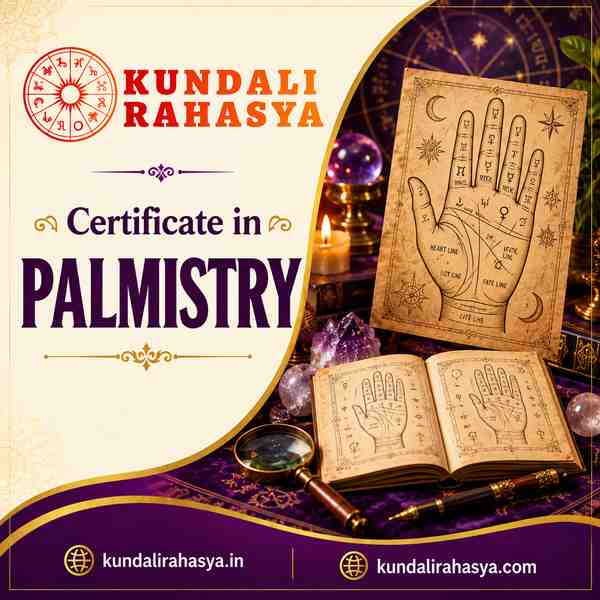
Palmistry is a traditional interpretive practice involving the observation of the hands and their visible features. The Certificate in Palmistry introduces learners to the fundamental concepts of palm reading, including hand shapes, fingers, mounts, major lines, minor lines, and their traditional interpretations.
The course covers basic palmistry terminology, hand structure, line identification, finger characteristics, and commonly discussed palm markings. Learners practise observing visible features, comparing different palm patterns, recording observations systematically, reviewing traditional interpretations, and explaining their findings in clear and responsible language.
Palmistry is not scientifically validated as a reliable method for predicting life events or determining personality. Learners should distinguish visible observations from traditional interpretations, avoid absolute predictions, respect personal boundaries, and communicate the limitations of palmistry responsibly.
Course Details
- Course Name: Certificate in Palmistry
- Course Code: KR/CP/PAL2567
- Course Level: Professional Certificate
- Eligibility: 10th Pass or Equivalent
- Duration: 3 Months
- Learning Mode: Online / Self-Paced / Recorded Lectures
- Examination Mode: Online MCQ Examination
- Certificate Validity: Lifetime
- Certificate Verification: Online Verification Facility
About the Certificate in Palmistry Course
This course introduces the foundational study of hands and their commonly discussed meanings within traditional palmistry. Learners examine hand shapes, fingers, thumb characteristics, mounts, major lines, minor lines, and visible markings to understand the basic framework used in palm reading.
The programme emphasises systematic observation, sample-based exercises, consistent documentation, and responsible interpretation. Learners practise identifying visible palm features before discussing their traditional meanings and avoid presenting palmistry interpretations as scientifically established conclusions, certain predictions, or professional assessments.
Course Objective
The objective is to develop foundational knowledge of traditional palmistry and help learners identify, observe, document, and interpret visible hand characteristics within a structured learning framework.
Learners will study:
- Introduction to palmistry and its traditional background.
- Basic terminology used in palm reading.
- Identification of different hand shapes and structures.
- Observation of fingers, finger proportions, and their characteristics.
- Introduction to thumb analysis and its traditional interpretations.
- Identification of the major lines of the palm.
- Introduction to minor lines and their commonly discussed meanings.
- Study of the heart line and its traditional symbolism.
- Study of the head line and its conventional interpretations.
- Study of the life line and its traditional associations.
- Introduction to the fate line and other commonly discussed lines.
- Identification of the mounts of the palm.
- Observation of visible palm markings and line variations.
- Relationship between hand shape, fingers, mounts, and lines.
- Methods for recording palm observations consistently.
- Reviewing sample hands and practical examples.
- Comparing traditional interpretations across different examples.
- Distinguishing visible characteristics from traditional meanings.
- Understanding ethical boundaries and the limitations of palmistry.
Admission, Learning, Examination & Certification Process
Step 1 – Select Your Course: Review the course overview, eligibility, duration, learning outcomes, and syllabus before enrolling.
Step 2 – Complete Online Enrollment: Submit the required registration details through the official enrollment process.
Step 3 – Make Secure Payment: Pay the applicable course fee through the available payment facility and retain the confirmation for reference.
Step 4 – Receive Learning Access: After enrollment processing, access instructions and study materials are provided through the designated channel.
Step 5 – Study Online: Complete recorded lessons and observation exercises at your own pace, revisiting important concepts when needed.
Step 6 – Appear for the Online Examination: Complete the online MCQ examination according to the course administrator’s instructions.
Step 7 – Receive Your Certificate: Eligible learners receive a certificate according to the organisation’s certification procedure and applicable delivery arrangements.
Step 8 – Online Certificate Verification: Use the available verification facility to check issued certificate details where applicable.
Step 9 – Career Guidance & Job Assistance: Guidance may help learners explore relevant areas but does not guarantee employment, clients, or income.
Who Should Enroll in the Certificate in Palmistry Course?
The course may suit beginners, traditional metaphysics students, aspiring palmistry learners, and individuals interested in understanding the basic principles of hand analysis through structured learning.
Learners should be willing to study terminology, observe visible palm features carefully, review sample hands, maintain notes, and communicate responsibly. Prior professional experience is not specified as a requirement.
Core Learning Areas
Foundations of Palmistry
Study the traditional background of palmistry, introductory terminology, and the general approach used to observe and describe hands.
Hand Shape and Structure
Explore commonly discussed hand shapes, general proportions, and their traditional interpretations.
Finger and Thumb Analysis
Study finger characteristics, thumb structure, and their commonly discussed symbolic associations within palmistry.
Major Palm Lines
Identify the heart line, head line, life line, fate line, and other major lines, including their general characteristics and traditional interpretations.
Minor Lines and Mounts
Explore commonly discussed minor lines, palm mounts, and their conventional symbolic meanings.
Comparative Observation and Documentation
Practise comparing palm features across different hands and sample images, recording similarities and differences in an organised format.
Practical Analysis and Sample Cases
Review sample hands, identify visible palm features, prepare structured notes, and explain traditional interpretations in clear, balanced language.
Ethics, Privacy and Professional Boundaries
Explore consent, confidentiality, respectful communication, and the limitations of traditional palmistry.
Certificate in Palmistry Syllabus
Module 1: Introduction to Palmistry
Traditional background, introductory terminology, general principles of palm reading, hand orientation, and an introduction to visible palm features.
Module 2: Hand Shape, Fingers and Thumb
Study of commonly discussed hand shapes, finger proportions, thumb characteristics, and their traditional interpretations within palmistry.
Module 3: Major Palm Lines
Identification of the heart line, head line, life line, and fate line, including their general appearance, variations, and commonly discussed meanings.
Module 4: Minor Lines, Mounts and Markings
Introduction to commonly discussed minor lines, mounts of the palm, visible markings, and their traditional symbolic associations.
Module 5: Practical Observation and Sample Analysis
Review sample hands, identify visible characteristics, record observations, compare examples, and prepare structured notes that separate observations from traditional interpretations.
Module 6: Ethics and Responsible Practice
Study of confidentiality, consent, respectful communication, professional boundaries, and the limitations of palmistry as a traditional interpretive practice.
Palmistry Assessment Framework
Requirement Review
Understand the purpose of an assessment exercise and identify the supplied learning materials, sample images, and palm-observation requirements.
Visual Observation
Describe visible hand characteristics, including hand shape, finger proportions, palm lines, mounts, and markings before forming an interpretation.
Hand Shape Recognition
Identify commonly discussed hand shapes and demonstrate familiarity with their general characteristics and traditional terminology.
Finger and Thumb Review
Describe visible finger and thumb characteristics while distinguishing observation from interpretation.
Major Line Recognition
Identify the major palm lines and demonstrate familiarity with their general locations, visible features, and traditional terminology.
Minor Line and Mount Observation
Recognise commonly discussed minor lines and mounts and record their visible characteristics without assigning certain predictions.
Palm Marking Observation
Identify visible markings and line variations where present and describe their appearance without unsupported conclusions.
Observation Record Quality
Prepare consistent notes that describe visible palm characteristics accurately and distinguish observations from assumptions.
Comparative Palm Observation
Compare hand shapes, fingers, lines, and mounts across different sample images and record similarities or differences without unsupported conclusions.
Traditional Interpretation Review
Explain how palm features are interpreted within traditional palmistry and distinguish those interpretations from direct observation or established scientific evidence.
Communication and Ethics
Demonstrate awareness of respectful language, confidentiality, consent, realistic expectations, and the boundaries of traditional interpretive practices.
Final Evaluation
Complete the online MCQ examination and meet the organisation’s applicable course-completion and assessment requirements.
Certification Process
Learners who complete the course and fulfil the applicable assessment requirements may receive the Certificate in Palmistry according to the organisation’s certification procedures. Certificate details can be checked through the online verification facility where provided. The stated certificate validity is lifetime, subject to the organisation’s verification and record policies.
Career Opportunities
This course introduces foundational palmistry concepts and structured observation methods for further study and responsible exploration of related activities.
Possible directions include educational content creation, workshop assistance, learning support, or introductory palm-reading practice within the limits of one’s competence. Opportunities depend on knowledge, experience, communication skills, demand, and ethical practice.
Course completion does not guarantee employment, clients, professional recognition, or income. Learners should describe their training accurately and avoid presenting traditional interpretations as scientifically proven findings or certain predictions.
Scope for Independent Palmistry Practice
Learners may develop activities involving:
- Educational explanations of traditional palmistry terminology.
- Identification of commonly discussed hand shapes.
- Guided observation of finger and thumb characteristics.
- Identification of major palm lines.
- Observation of commonly discussed minor lines.
- Introduction to the mounts of the palm.
- Description of visible palm markings and line variations.
- Comparison of palm features across different sample hands.
- Observation of hands alongside their overall structure.
- Preparation of structured palm-observation worksheets.
- Review of sample palm-reading cases.
- Preparation of educational materials and reference notes.
- Introductory workshops about palmistry fundamentals.
- Clear separation of visible observations and traditional meanings.
- Continued study of palmistry and ethical communication.
Independent practitioners should communicate their experience honestly, obtain consent before using personal information, protect client privacy, and avoid guaranteed predictions or fear-based claims. Palmistry should not be presented as a scientifically proven predictive method or a substitute for qualified professional advice.
Expected Income & Earning Potential
Income varies by experience, service type, demand, and costs. These figures are illustrative, not verified salary benchmarks.
Indicative ranges:
- Beginner / Entry-Level: ₹1,80,000 – ₹4,00,000 per year
- Experienced Practitioner: ₹4,00,000 – ₹8,00,000 per year
- Independent Practitioner: ₹6,00,000 – ₹12,00,000+ per year
- Established Professional: ₹9,00,000 – ₹16,00,000+ per year
These figures are not guaranteed. Actual income varies, and course completion does not guarantee clients or employment.
Why Choose an Online Certificate in Palmistry
The online format lets learners revisit recorded lessons, review palmistry concepts, and practise observation exercises at a manageable pace.
The syllabus combines foundational palmistry, structured observation, sample-based analysis, documentation, and responsible communication.
What is a Certificate in Palmistry?
It is an introductory educational programme covering traditional palmistry concepts through the study of hand shapes, fingers, thumb characteristics, major lines, minor lines, mounts, and their conventional interpretations.
Can I study Palmistry online?
Yes. The stated learning mode is online, self-paced study with recorded lectures and supporting learning resources, subject to the organisation’s course arrangements.
What practical skills will I develop?
You will practise identifying commonly discussed hand shapes, fingers, palm lines, mounts, and markings, recording findings, reviewing sample hands, and distinguishing observations from traditional interpretations.
What is the eligibility for this course?
The stated eligibility is 10th Pass or Equivalent. Applicants should also complete the institution’s applicable registration requirements.
Is prior knowledge of palmistry required?
Prior professional experience is not specified as a requirement. The course introduces foundational concepts, and learners should be prepared to study the terminology and practise systematically.
Is the examination conducted online?
Yes. The stated examination mode is an online MCQ examination. Learners should follow the administrator’s instructions and fulfil the applicable assessment requirements.
What will I learn in this course?
You will study hand shapes, finger and thumb characteristics, major palm lines, minor lines, mounts, visible markings, traditional interpretations, practical observation, and ethical communication.
Can I offer palm-reading services after completing the certificate?
You may explore related activities within your knowledge and competence, subject to applicable requirements. The certificate does not guarantee clients or income, and interpretations should not be presented as scientifically proven predictions.
Is the certificate verifiable online?
An online certificate verification facility is listed in the course details. Learners can use the organisation’s official verification process to check issued certificate information.
Who can join this course?
Beginners, palmistry learners, aspiring practitioners, traditional metaphysics students, and individuals interested in the structured study of hands within palmistry may consider enrolling.
