
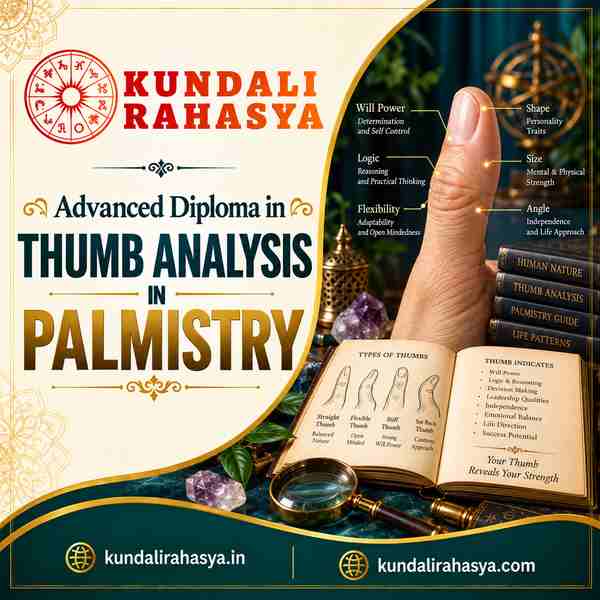
Description
Course Name: Advanced Diploma in Thumb Analysis in Palmistry
The Advanced Diploma in Thumb Analysis in Palmistry introduces learners to the traditional study of the thumb within palmistry. It explores visible characteristics such as thumb length, shape, setting, angle, flexibility, proportions, and the relationship between the thumb and the rest of the hand.
The course focuses on systematic observation, traditional classifications, comparative study, and clear record keeping. Learners examine how different palmistry traditions interpret thumb features while distinguishing visible descriptions from symbolic meanings and avoiding conclusions based on one feature alone.
Thumb analysis is presented as a traditional interpretive practice, not as a scientifically established method for determining personality or predicting life events. Learners are encouraged to use balanced language, respect individual differences, and communicate the limitations of interpretations responsibly.
Course Details
- Course Name: Advanced Diploma in Thumb Analysis in Palmistry
- Course Code: KR/AD/TAP2528
- Course Level: Advanced Diploma
- Eligibility: 10th Pass or Equivalent
- Duration: 6 Months
- Learning Mode: Online / Self-Paced / Recorded Learning Resources
- Examination Mode: Online MCQ Examination
- Certificate Validity: Lifetime
- Certificate Verification: Online Verification Facility
About the Advanced Diploma in Thumb Analysis in Palmistry Course
This course explores how the thumb is observed and discussed in traditional palmistry. Learners study its visible proportions, apparent flexibility, placement on the hand, angle, shape, and relationship with the palm and fingers.
Emphasis is placed on observation before interpretation. Learners practise recording visible details, comparing features consistently, and using neutral language to distinguish physical observations from traditional symbolic associations. Different interpretive approaches are considered without presenting them as scientifically established findings.
The course also introduces responsible consultation practices, including privacy, cultural sensitivity, and avoiding absolute claims. Learners are encouraged to recognise individual variation and to explain that thumb-based interpretations are part of a traditional practice rather than validated assessments of character or future events.
Course Objective
The objective of this course is to develop a structured understanding of thumb analysis within traditional palmistry and help learners observe, record, compare, and discuss thumb features in a careful and ethical manner.
Learners will study:
Thumb analysis and its place in palmistry traditions
Basic thumb anatomy and visible characteristics
Thumb length, shape, and proportion
Thumb setting, angle, and position in relation to the hand
Apparent flexibility and movement as observable features
The relationship between the thumb, palm, and fingers
Traditional symbolic associations linked with thumb features
Comparing thumb characteristics without rigid assumptions
Recording observations in a clear, consistent format
Recognising natural variation and uncertainty
Combining thumb observations with other palmistry features
Communicating interpretations responsibly and respectfully
Admission, Learning, Examination & Certification Process
Step 1 – Select Your Course: Review the course details and confirm that the Advanced Diploma in Thumb Analysis in Palmistry matches your learning interests.
Step 2 – Complete Online Enrollment: Submit the online enrollment form with the required information.
Step 3 – Make Secure Payment: Complete the applicable course payment through the available payment facility.
Step 4 – Receive Learning Access: Access details and learning resources are provided according to the course enrollment process.
Step 5 – Study Online: Work through the recorded learning resources at your own pace and revise the topics as needed.
Step 6 – Appear for the Online Examination: Complete the online MCQ examination according to the examination instructions.
Step 7 – Receive Your Certificate: Learners who meet the course and assessment requirements can receive their course completion certificate.
Step 8 – Online Certificate Verification: Use the available online verification facility to check certificate details.
Step 9 – Career Guidance & Job Assistance: General career guidance may be provided where available; employment, clients, and earnings are not guaranteed.
Who Should Enroll in the Advanced Diploma in Thumb Analysis in Palmistry Course?
This course is suitable for learners interested in palmistry, traditional hand-reading systems, or the systematic observation of thumb features. It may also suit existing palmistry learners who want to strengthen their descriptive skills and explore how the thumb is treated in different interpretive traditions.
Learners should be willing to practise careful observation, keep organised notes, and explain the traditional nature and limitations of palmistry interpretations. Course completion does not establish scientific expertise or qualify learners to make medical, psychological, or other high-stakes assessments.
Core Learning Areas
Foundations of Thumb Analysis
Explore the role of the thumb in traditional palmistry and distinguish visible characteristics from symbolic interpretations.
Thumb Shape and Proportion
Study thumb length, apparent thickness, shape, and proportion in relation to the hand using consistent descriptive language.
Thumb Setting and Angle
Observe the thumb’s placement and angle relative to the palm, recording visible differences without assuming fixed meanings.
Flexibility and Movement
Consider apparent thumb flexibility and movement as observational features, recognising natural variation and avoiding unsupported conclusions.
Traditional Thumb Associations
Review symbolic meanings associated with thumb features in palmistry traditions while recognising that interpretations vary.
Comparative Thumb Observation
Practise comparing thumb features across hands and individuals, noting similarities and differences without treating them as universal rules.
Integrated Analysis and Case Records
Organise thumb observations alongside other hand features and maintain clear records that separate description from interpretation.
Consultation Practice and Ethics
Develop respectful communication, privacy awareness, non-discriminatory language, and responsible boundaries when discussing traditional readings.
Advanced Diploma in Thumb Analysis in Palmistry Syllabus
Module 1: Introduction to Thumb Analysis
Traditional and historical context of thumb analysis; visible description versus interpretation; observation methods and the limitations of palmistry claims.
Module 2: Thumb Shape and Proportion
Thumb length, shape, apparent thickness, proportion to the hand, descriptive terminology, and structured observation exercises.
Module 3: Thumb Setting, Angle, and Flexibility
Thumb placement, angle, apparent flexibility, movement, natural variation, and methods for recording observable features consistently.
Module 4: Traditional Thumb Associations
Traditional symbolic associations linked with thumb characteristics; comparison of interpretive approaches; avoiding fixed labels and absolute conclusions.
Module 5: Comparative and Integrated Observation
Comparing thumb characteristics, noting differences between hands, creating case records, and relating thumb observations to other palmistry features with appropriate caution.
Module 6: Consultation, Ethics and Final Assessment
Responsible communication, confidentiality, respectful practice, revision of core concepts, practical observation exercises, and preparation for the online MCQ examination.
Advanced Diploma in Thumb Analysis in Palmistry Assessment Framework
Thumb Feature Identification
Identify visible thumb features in descriptions or learning examples and state which observable details support the description.
Shape and Proportion Observation
Describe thumb shape and relative proportions using consistent and neutral terminology.
Setting and Angle Observation
Recognise differences in thumb placement and angle and record them without assuming that they determine personality.
Flexibility Observation
Describe apparent flexibility or movement as an observable feature while recognising individual variation.
Traditional Association Recognition
Identify symbolic associations presented in the course and distinguish traditional interpretations from scientifically established facts.
Feature Recording
Prepare concise notes that clearly separate visible observations from traditional interpretations.
Pattern Recognition
Recognise combinations of thumb features in learning examples without treating them as universal or conclusive.
Comparative Thumb Analysis
Compare observations across hands and describe similarities, differences, and uncertainty.
Observation Records
Maintain organised, neutral records using consistent terminology and avoiding unsupported personal assumptions.
Integrated Interpretation
Combine thumb observations with other course concepts in a balanced, qualified discussion.
Ethical Understanding
Demonstrate awareness of privacy, respectful language, limitations, and the need to avoid definitive or harmful claims.
Final Assessment
Complete the online MCQ examination covering thumb features, traditional associations, observation methods, comparative analysis, and ethical practice.
Certification Process
Learners who complete the required learning and meet the assessment criteria may receive the Advanced Diploma in Thumb Analysis in Palmistry certificate. The certificate has lifetime validity and can be checked through the available online verification facility. Certification confirms course completion; it does not establish scientific accreditation or guarantee employment, professional recognition, or income.
Career Opportunities
Learners may use this course as supplementary study alongside broader learning in traditional palmistry. Potential activities may include preparing educational content, supporting introductory workshops, or organising observation materials for learning purposes.
Those who offer independent readings should explain that thumb interpretations are part of traditional palmistry and are not scientifically validated assessments of personality or future events. They should avoid medical, psychological, financial, or other high-stakes claims.
Career outcomes depend on individual skills, experience, communication, local requirements, and demand. The course does not guarantee employment, clients, business success, or a particular level of earnings.
Scope for Independent Thumb Analysis in Palmistry Practice
After study and practice, learners may explore the following activities within responsible and clearly stated boundaries:
Describing visible thumb features
Recording thumb length and proportion
Observing thumb shape and setting
Describing thumb angle and placement
Noting apparent flexibility and movement
Comparing thumb characteristics
Reviewing traditional thumb associations
Preparing structured observation notes
Creating educational palmistry content
Developing beginner learning materials
Conducting non-definitive practice discussions
Maintaining anonymised practice records
Explaining differences between interpretive traditions
Discussing readings respectfully
Continuing study of traditional palmistry
Expected Income & Earning Potential
Earnings vary considerably with experience, location, demand, communication skills, business costs, and the services offered. The following figures are illustrative possibilities only, not verified industry benchmarks or promised outcomes.
Indicative ranges:
- Beginner: ₹1,80,000 – ₹4,00,000 per year
- Experienced: ₹4,00,000 – ₹8,00,000 per year
- Independent Practitioner: ₹6,00,000 – ₹12,00,000+ per year
- Established Practitioner: ₹9,00,000 – ₹16,00,000+ per year
Actual earnings may be lower or higher, and some learners may earn nothing from this subject. Course completion does not guarantee employment, clients, or income.
Why Choose an Online Advanced Diploma in Thumb Analysis in Palmistry?
Online learning gives learners the flexibility to study at a suitable pace and revisit recorded resources when needed. This supports repeated practice of observation and terminology.
A structured syllabus takes learners from basic thumb features through traditional associations, comparative observation, case records, and responsible communication.
The course can complement wider palmistry study, provided learners maintain realistic expectations and communicate clearly about the traditional and non-scientific status of thumb interpretations.
What is thumb analysis in palmistry?
It is a traditional palmistry approach that observes thumb characteristics and interprets them through particular symbolic systems. These interpretations are not scientifically established assessments of personality or future events.
Who can enroll in this course?
Anyone who meets the stated eligibility of 10th Pass or Equivalent and is interested in traditional thumb analysis may enroll.
What is the duration of the course?
The course duration is 6 months, with online, self-paced learning resources.
Is prior palmistry experience required?
Prior experience may be helpful, but the course introduces foundational observation methods for learners who are new to the topic.
What will I learn in this course?
You will study thumb shape, length, proportion, setting, angle, apparent flexibility, traditional associations, comparative observation, case records, and ethical communication.
Is the course delivered online?
Yes. Learning is offered through online, self-paced, recorded learning resources.
How is the examination conducted?
The examination mode is an online MCQ examination, subject to the instructions provided for the course.
Does the certificate have lifetime validity?
Yes. The stated certificate validity is lifetime, and an online certificate verification facility is available.
Can this course guarantee a job or income?
No. The course does not guarantee employment, clients, business success, or income. Outcomes depend on individual and market factors.
Is thumb analysis scientifically proven?
No. Palmistry-based thumb interpretations are traditional and should not be presented as scientifically validated conclusions about personality, health, or future events.
