
Description
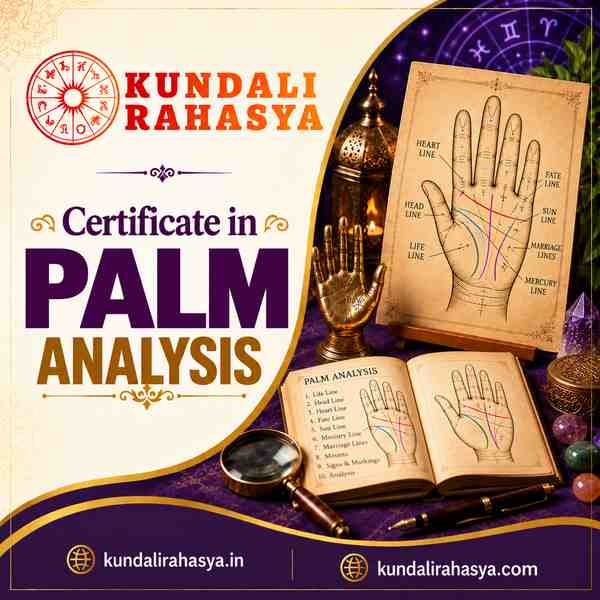
Course Name: Certificate in Palm Analysis
Palm analysis involves the systematic observation of palm structure, major lines, mounts, fingers, thumb features, and visible markings within traditional palmistry. The Certificate in Palm Analysis introduces learners to an organized method of examining these features, recording observations, and understanding the terminology used in traditional interpretive practices.
The course progresses from foundational concepts to detailed feature identification, comparative observation, and integrated case documentation. Learners develop a step-by-step approach to describing the hand and reviewing customary interpretations. The program also emphasizes responsible communication and recognizes that palmistry is not scientifically validated as a reliable method for determining personality or predicting future events.
Course Details
- Course Name: Certificate in Palm Analysis
- Course Code: KR/CP/PAN352
- Course Level: Professional Certificate
- Eligibility: 10th Pass or Equivalent
- Duration: 3 Months
- Learning Mode: Online / Self-Paced / Recorded Lectures
- Examination Mode: Online MCQ Examination
- Certificate Validity: Lifetime
- Certificate Verification: Online Verification Facility
About the Certificate in Palm Analysis Course
The Certificate in Palm Analysis provides a structured introduction to traditional palm examination. Learners begin by understanding hand orientation, palm regions, overall proportions, and observation terminology. They then study the commonly discussed Life Line, Head Line, Heart Line, Fate Line, and Sun Line, alongside principal mounts, finger proportions, thumb structure, and variations in visible markings.
The program encourages learners to examine multiple features rather than base an interpretation on a single line or sign. Practical exercises help learners document what they observe, compare features, and organize their findings into a clear summary. Attention is also given to consent, confidentiality, interpretive uncertainty, and the distinction between a visible characteristic and a traditional symbolic association.
Course Objective
The objective is to develop a systematic foundation in traditional palm analysis. Learners will practise identifying hand features, recording observations, reviewing customary interpretations, and presenting organized summaries with appropriate qualifications.
Learners will study:
- Palm analysis terminology and hand orientation
- Palm regions, shape, and proportions
- Identification of major palm lines
- Life Line, Head Line, and Heart Line features
- Fate Line and Sun Line observation
- Principal mounts and their locations
- Finger proportions, fingertips, spacing, and thumb structure
- Line length, depth, clarity, and continuity
- Branches, breaks, intersections, and visible variations
- Comparison of observations from both hands
- Integration of lines, mounts, and finger features
- Step-by-step traditional analysis methods
- Observation sheets and sample case documentation
- Clear explanations and professional communication
- Consent, confidentiality, and ethical practice
Admission, Learning, Examination & Certification Process
Step 1 – Select Your Course: Choose the Certificate in Palm Analysis after reviewing its course details, learning outcomes, duration, and eligibility requirements.
Step 2 – Complete Online Enrollment: Submit the required registration information and check that the details provided are accurate.
Step 3 – Make Secure Payment: Pay the applicable course and examination fee through the payment methods made available by the institution.
Step 4 – Receive Learning Access: Following enrollment processing, receive the learning access instructions and login details according to the institution’s process.
Step 5 – Study Online: Follow the recorded lectures and learning materials in sequence. Complete observation exercises and prepare notes using the recommended terminology.
Step 6 – Appear for the Online Examination: After completing the required learning, attempt the online MCQ examination according to the published assessment instructions.
Step 7 – Receive Your Certificate: Candidates who successfully meet the applicable examination and completion requirements receive the relevant certificate according to the institution’s process.
Step 8 – Online Certificate Verification: The authenticity of an issued certificate can be checked through the available online verification facility.
Step 9 – Career Guidance & Job Assistance: Eligible certified candidates may receive career guidance or information about suitable opportunities where available. Job assistance does not guarantee employment or placement.
Who Should Enroll in the Certificate in Palm Analysis Course?
This Professional Certificate may suit beginners, palmistry learners, traditional knowledge enthusiasts, astrology and numerology students, educators, and individuals interested in systematic hand observation. Previous experience may be useful but is not mandatory, subject to the published eligibility requirements.
Core Learning Areas
Systematic Palm Observation
Learn to examine the hand in an organized sequence, identify palm regions, and describe visible characteristics before considering traditional meanings. Practise using observation sheets and consistent terminology.
Major Lines & Structural Features
Study the Life Line, Head Line, Heart Line, Fate Line, and Sun Line. Describe their position, length, clarity, direction, continuity, and visible variations without treating individual markings as certain forecasts.
Mounts, Fingers & Thumb
Explore principal mount locations, finger proportions, fingertip shapes, spacing, joints, and thumb structure. Record relative prominence and visible form without presenting these features as medical findings or definitive measures of personality.
Integrated Traditional Analysis
Combine observations of lines, mounts, fingers, and thumb into a structured review. Consider several features together, recognize differences between traditional schools, and avoid drawing conclusions from isolated markings.
Practical Documentation & Communication
Prepare readable case notes that separate direct observations from customary interpretations. Practise explaining the reasoning behind a traditional reading in accessible language while acknowledging uncertainty and interpretive limitations.
Ethics & Responsible Practice
Understand consent, confidentiality, respectful communication, and appropriate professional boundaries. Avoid fear-based predictions, guaranteed claims, and advice that substitutes for qualified medical, legal, financial, or other professional guidance.
Certificate in Palm Analysis Syllabus
Module 1: Foundations of Palm Analysis
Study the background and terminology of traditional palm analysis, hand orientation, palm regions, and systematic observation. Learn to record visible characteristics before considering customary meanings. Introduce the limitations of predictive claims and the importance of neutral descriptions.
Module 2: Major Lines & Their Variations
Identify the Life Line, Head Line, Heart Line, Fate Line, and Sun Line. Examine their location, course, clarity, continuity, and visible variations. Practise describing branches, breaks, and intersections while keeping physical observations separate from traditional interpretations.
Module 3: Mounts, Fingers & Thumb Assessment
Explore principal mount locations and their relative prominence. Study finger proportions, fingertip shapes, spacing, joints, and thumb structure. Practise describing visible features consistently and review how different traditional approaches assign symbolic associations to them.
Module 4: Integrated Palm Examination
Combine observations of hand shape, major lines, mounts, fingers, and thumb into an organized review. Compare features from both hands when appropriate, record similarities and differences, and avoid relying on a single marking to support an overall interpretation.
Module 5: Practical Analysis & Case Documentation
Work through sample cases using a consistent sequence: observe, describe, review customary interpretations, and prepare a qualified summary. Create concise notes that distinguish visible characteristics from assumptions. Practise presenting findings clearly and responding respectfully to questions.
Module 6: Ethics, Reporting & Assessment Preparation
Review consent, confidentiality, responsible communication, and interpretive limitations. Practise explaining uncertainty and avoiding deterministic statements about health, wealth, relationships, or future events. Revise key terminology and prepare for the online MCQ examination.
Certificate in Palm Analysis Assessment Framework
Hand Observation
Identify palm regions and record visible characteristics using a consistent observation process. Demonstrate the ability to distinguish direct description from assumption.
Major Line Identification
Recognize the major lines and describe their location, clarity, course, continuity, and visible variations using appropriate terminology.
Mount, Finger & Thumb Assessment
Demonstrate foundational knowledge of principal mounts, finger proportions, fingertips, and thumb structure. Record observations without making unsupported claims about personality or destiny.
Traditional Interpretation
Explain selected customary meanings while recognizing differences among palmistry traditions and the limits of predictive interpretations.
Integrated Palm Analysis
Combine multiple observations into an organized traditional analysis without presenting symbolic associations as established facts or guaranteed outcomes.
Practical Case Documentation
Prepare readable notes that distinguish visible features, customary meanings, and areas of uncertainty. Apply a consistent checklist to sample cases.
Ethical Professional Presentation
Demonstrate respectful communication, confidentiality, consent, and appropriate boundaries when explaining traditional interpretations.
Certification Process
Candidates who successfully complete the applicable examination and course requirements receive a digital certificate by registered email and an original certificate according to the institution’s dispatch process. Issued certificates can be authenticated through the online verification facility. Certificate validity is lifetime, subject to the institution’s applicable certification policy.
Career Opportunities
After completing the Certificate in Palm Analysis, learners may explore opportunities according to their practical competence, experience, communication skills, and continued learning. Potential directions include Palm Analysis Practitioner, Hand Reading Consultant, Traditional Palmistry Content Creator, Workshop Facilitator, Educational Resource Developer, and Online Consultation Provider.
Learners may also continue into more specialized palmistry studies or create educational resources explaining traditional methods. Opportunities depend on individual circumstances, local demand, and the nature of services offered. Employment, client acquisition, and income are not guaranteed.
Scope for Independent Palm Analysis
Learners may develop their knowledge through structured educational or interpretive activities, including:
- Systematic Hand Observation
- Palm Shape and Proportion Assessment
- Major Line Identification
- Life Line and Head Line Observation
- Heart Line and Fate Line Description
- Sun Line Introduction
- Mount Identification and Comparison
- Finger and Thumb Observation
- Line Variation Documentation
- Comparative Hand Study
- Integrated Traditional Analysis
- Observation Sheet Development
- Sample Case Documentation
- Educational Articles and Learning Resources
- Introductory Workshops
- Online Hand Reading Sessions
These activities should be presented as traditional interpretive services rather than scientifically established methods for determining personality, health, wealth, relationships, or future outcomes. Practitioners should protect personal information, seek permission when observing or recording another person’s hand, and avoid deterministic claims.
Expected Income & Earning Potential
Earning potential varies according to experience, location, service format, client volume, fees, reputation, business costs, and time devoted to practice. The following figures are illustrative estimates only, not verified salary data or guaranteed earnings:
- Beginner / Entry-Level: ₹2,50,000 – ₹5,00,000 per year
- Experienced Consultant: ₹5,00,000 – ₹10,00,000 per year
- Independent Practitioner: ₹7,00,000 – ₹15,00,000+ per year
- Established Professional: ₹12,00,000 – ₹20,00,000+ per year
These ranges should not be treated as expected outcomes from course completion. Actual income depends on individual circumstances and market demand. Anyone considering paid services should evaluate costs, communicate the service’s limitations, and follow applicable requirements.
Why Choose an Online Certificate in Palm Analysis?
The online learning format offers flexibility for learners balancing work, family, or other commitments. Recorded lectures can be revisited, while the organized syllabus supports progression from basic terminology to integrated observation and case documentation.
The course is suitable for beginners seeking a guided introduction to traditional palm analysis. Its emphasis on structured observation, practical exercises, and responsible communication helps learners develop a consistent approach to study without presenting symbolic interpretations as scientific conclusions.
What is a Certificate in Palm Analysis?
It is a Professional Certificate program introducing systematic hand observation, major lines, mounts, fingers, thumb features, traditional interpretations, and organized case documentation.
Can I study Palm Analysis online?
Yes. The stated learning mode is online, self-paced, and based on recorded lectures, with an online MCQ examination according to the course process.
What practical skills will I develop?
Learners practise identifying hand features, describing visible characteristics, comparing observations, preparing case notes, and explaining traditional interpretations in balanced language.
What is the eligibility requirement?
The stated minimum eligibility is 10th Pass or Equivalent. Applicants should confirm any current admission requirements with the course provider.
Is previous palmistry knowledge required?
Previous knowledge may be helpful but is not mandatory, subject to published eligibility requirements. The course begins with foundational concepts before introducing integrated analysis.
Is the examination conducted online?
Yes. The stated examination mode is an online MCQ examination, subject to the applicable instructions and course completion requirements.
What topics are included in the syllabus?
The syllabus covers hand structure, palm proportions, major lines, mounts, fingers, thumb features, line variations, integrated observation, case documentation, and responsible communication.
Can Palm Analysis predict the future with certainty?
No. Scientific evidence does not establish palmistry as a dependable method for predicting health, wealth, relationships, or future events. The course examines traditional interpretive approaches rather than guaranteed outcomes.
Is the certificate verifiable online?
Yes. Issued certificates can be checked through the available online certificate verification facility according to the institution’s process.
Who can enroll in this course?
Beginners, palmistry learners, traditional knowledge enthusiasts, educators, and students of related subjects may find the course useful, subject to the stated eligibility requirements.
