
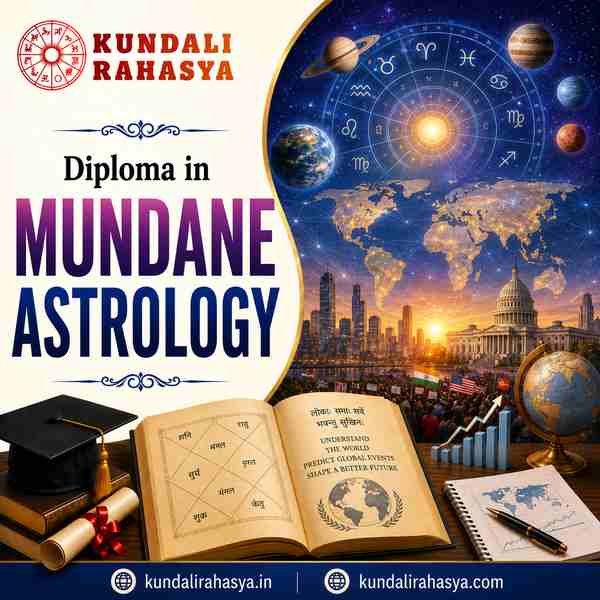
Description
Course Name: Diploma in Mundane Astrology
Develop practical knowledge of Mundane Astrology, traditional astrological methods for analysing countries, governments, public affairs, social trends and major collective events with the Diploma in Mundane Astrology. This professional online course covers Mundane Astrology fundamentals, national charts, ingress charts, planetary cycles, eclipses, planetary transits, political astrology, economic trends, natural events, public sentiment, international relations, national developments, event analysis, practical charts, case studies and professional consultation.
Course Details
- Course Name: Diploma in Mundane Astrology
- Course Code: KR/DMA/A23
- Course Level: Professional Diploma
- Eligibility: 12th Pass or Equivalent
- Duration: 12 Months
- Learning Mode: Online / Self-Paced / Recorded Lectures
- Examination Mode: Online MCQ Examination
- Certificate Validity: Lifetime
- Certificate Verification: Online Verification Facility
About the Course
The Diploma in Mundane Astrology is designed for learners who want to develop specialized knowledge of traditional astrological methods used to study collective events, countries, governments, institutions and broader social developments.
The course introduces the foundations of Mundane Astrology and national horoscope analysis, followed by the study of planetary cycles, ingresses, eclipses, transits and other traditional indicators used in collective-event interpretation.
Learners are introduced to traditional approaches for analysing political developments, government changes, economic themes, social movements, international relations, public sentiment and significant national or global events. The program combines theoretical learning with practical chart analysis, historical examples and case studies while emphasizing responsible interpretation rather than deterministic forecasting.
Course Objectives
After completing this course, learners should have a better understanding of:
- Fundamentals of Mundane Astrology
- History of Mundane Astrology
- Scope of national astrology
- National and country charts
- Inception and foundation charts
- Capital-city charts
- Government and institutional charts
- Political Astrology
- Planetary cycles
- Planetary ingresses
- Solar ingress charts
- Lunar cycles
- Planetary transits
- Eclipses
- New Moon and Full Moon charts
- Retrograde planetary periods
- Conjunctions and major planetary aspects
- Angular planetary positions
- Mundane houses
- Sign and house symbolism
- Planetary rulership
- National prosperity indicators
- Political developments
- Government changes
- Leadership transitions
- Public sentiment
- Social movements
- Economic trends
- Financial-market themes
- International relations
- Conflict and diplomatic developments
- Natural-event symbolism
- Weather-related traditional indicators
- Agricultural themes
- Public health-related traditional considerations
- Infrastructure and national development
- Foreign relations
- Regional and global event analysis
- Event timing
- Historical chart comparison
- Practical Mundane Astrology analysis
- Case studies
- Professional consultation
- Mundane Astrology report preparation
Who Should Enroll?
This course may be suitable for:
- Learners who have basic knowledge of astrology
- Diploma holders in Astrology or Jyotish
- Practising astrologers
- Aspiring professional astrologers
- Mundane Astrology students
- Vedic Astrology students
- Predictive astrology practitioners
- Horoscope analysts
- Astrology researchers
- Astrology teachers and trainers
- Political Astrology students
- Financial Astrology students
- KP Astrology students
- Astrology content creators
- Freelance consultants
- Individuals interested in traditional national and collective-event astrology
Basic knowledge of planets, zodiac signs, houses and horoscope structure is recommended.
Key Skills You Will Develop
Mundane Astrology Fundamentals
Develop a structured understanding of traditional astrological approaches used for studying nations, governments, institutions and collective developments.
National Chart Analysis
Learn how national or country charts may traditionally be constructed and interpreted for collective-event analysis.
Mundane House Analysis
Study the traditional meanings assigned to houses in Mundane Astrology and their relationship with different areas of national life.
Planetary Cycle Analysis
Understand the importance of major planetary cycles, conjunctions, aspects, ingresses and transits in traditional Mundane Astrology.
Political Astrology
Explore traditional methods for examining governments, leadership changes, political developments and public affairs.
Economic Astrology
Study traditional planetary and chart factors associated with economic conditions, financial trends, commerce and national resources.
Eclipse Analysis
Learn traditional approaches to analysing Solar and Lunar Eclipses and their relationship with national or regional charts.
International Relations
Develop traditional methods for analysing diplomatic relationships, international developments, alliances and conflicts.
Event Timing
Learn how planetary transits, ingresses, lunations and other traditional timing techniques may be examined for major collective events.
Historical Chart Research
Develop skills for comparing historical charts and events to study recurring traditional astrological patterns.
Practical Mundane Analysis
Strengthen analytical ability through national charts, historical events, case studies and structured interpretation exercises.
Professional Consultation
Learn how to organize Mundane Astrology research, prepare reports and communicate traditional interpretations responsibly.
Diploma in Mundane Astrology Syllabus
Module 1: Foundations of Mundane Astrology
Introduction to Mundane Astrology, historical development, scope and applications, difference between Natal and Mundane Astrology, countries and national entities, national horoscope concepts, foundation and independence charts, capital-city charts, government charts, institutional charts, Mundane houses, zodiac signs, planetary significators, planetary rulership, angles, Ascendant, Midheaven, planetary occupation, aspects and fundamental principles of collective-event interpretation.
Module 2: Planets, Houses and National Charts
Detailed study of Mundane houses, national resources, finance and economy, government and leadership, public administration, communication and transport, education and culture, law and justice, foreign affairs, religion and philosophy, public health, employment, agriculture, industry, infrastructure and public institutions. Planetary symbolism, planetary dignity, exaltation and debilitation, retrogression, combustion, conjunctions, aspects and practical national-chart interpretation.
Module 3: Planetary Cycles, Ingresses and Eclipses
Planetary cycles, Jupiter cycles, Saturn cycles, Uranus, Neptune and Pluto cycles within modern Mundane Astrology approaches, major planetary conjunctions, planetary ingresses, Solar ingress charts, Aries Ingress, Solar and Lunar Eclipses, New Moon charts, Full Moon charts, planetary stations, retrograde periods, eclipse paths, angularity, transit patterns, regional effects in traditional interpretation and practical event-analysis exercises.
Module 4: Political, Social and Economic Astrology
Political developments, government changes, leadership transitions, elections and public administration, political movements, public sentiment, social movements, economic cycles, national prosperity, financial markets, trade and commerce, taxation and public finance, employment themes, industrial developments, agriculture, infrastructure, technology, education, cultural developments, public institutions, international relations and practical historical case studies.
Module 5: International Events, Conflict and Collective Developments
International relations, diplomatic developments, alliances, treaties, geopolitical themes, traditional astrology of conflict, military developments, territorial issues, migration-related themes, international trade, regional developments, natural-event symbolism, weather-related traditional indicators, agricultural cycles, public health-related considerations, environmental themes, major collective events, regional chart comparison and advanced Mundane event analysis.
Module 6: Advanced Mundane Research and Professional Practice
Integrated national-chart analysis, combining natal national charts with transits, ingresses and eclipses, event chart comparison, historical research methodology, national horoscope databases, chart rectification concepts, event verification, planetary-cycle research, regional comparison, responsible interpretation, avoiding deterministic claims, distinguishing traditional astrological interpretation from factual forecasting, report preparation, client confidentiality, professional consultation, online research tools, astrology software, presentation techniques, Mundane Astrology content creation and final Mundane Astrology analysis project.
Admission, Learning, Examination and Certification Process
Step 1 – Select the Course: Choose the Diploma in Mundane Astrology from the course catalogue.
Step 2 – Complete Online Enrollment: Click Enroll Now and submit the required enrollment details.
Step 3 – Make Secure Payment: Pay the applicable fee using the available UPI, card, net-banking or digital-wallet options.
Step 4 – Receive Learning Access: Study-material login credentials will be sent to the registered email address within 48 hours after successful payment and enrollment processing.
Step 5 – Study Online: Access the available learning material and recorded lectures and complete the course within the prescribed duration.
Step 6 – Appear for the Examination: Complete the online MCQ examination after finishing the course study.
Step 7 – Receive the Certificate:
- Digital Certificate: Sent by email within seven working days after successful completion.
- Original Certificate: Dispatched to the registered address within 45 days from the declaration of results.
Step 8 – Online Verification: The issued certificate can be authenticated through the online certificate-verification facility.
Step 9 – Career Guidance: Eligible candidates may receive career guidance and information about relevant opportunities. Job assistance does not constitute a guarantee of employment.
Career Opportunities
Depending on their knowledge, practical competence and experience, learners may explore opportunities such as:
- Mundane Astrologer
- Mundane Astrology Consultant
- National Astrology Consultant
- Political Astrology Consultant
- World Astrology Consultant
- Collective Event Astrology Consultant
- Geopolitical Astrology Researcher
- Mundane Astrology Researcher
- Astrology Researcher
- Vedic Astrology Consultant
- Predictive Astrology Consultant
- Astrology Report Writer
- Astrology Content Creator
- Astrology Trainer
- Freelance Astrology Consultant
- Independent Mundane Astrology Practitioner
Scope for Independent Practice
Practitioners may offer services such as:
- National horoscope analysis
- Country chart analysis
- Mundane Astrology consultation
- Political Astrology analysis
- Government and leadership analysis
- Public-event astrology research
- Economic Astrology analysis
- Financial trend research
- International relations analysis
- Regional astrology research
- Eclipse analysis
- Planetary ingress analysis
- Planetary transit analysis
- Mundane event timing
- Historical astrology research
- National chart comparison
- Collective-event analysis
- Mundane Astrology reports
- Online Mundane Astrology consultations
- Mundane Astrology workshops and training
Professional outcomes depend on knowledge, experience, analytical ability, ethical practice, client base, reputation, service quality and applicable legal or platform requirements.
Frequently Asked Questions
What is the Diploma in Mundane Astrology?
It is a professional learning program covering traditional astrological methods for analysing nations, governments, political developments, economic themes, social trends and collective events.
What is the duration of the course?
The prescribed course duration is 12 months.
What is the eligibility requirement?
The minimum eligibility is 12th Pass or Equivalent. Basic knowledge of astrology is recommended.
Can I study this course online?
Yes. The course is offered through online, self-paced learning resources and recorded lectures.
Is the examination conducted online?
Yes. The assessment is conducted through an online MCQ examination.
What is Mundane Astrology?
Mundane Astrology is a traditional branch of astrology concerned with countries, governments, institutions, collective developments and major public events rather than individual birth charts alone.
What is a national horoscope?
A national horoscope is a chart constructed using a significant date and time associated with the establishment, independence, formation or another traditionally selected milestone of a country or national entity.
Does the course cover Political Astrology?
Yes. Traditional approaches to analysing governments, leadership, political developments, elections and public affairs are included.
Does the course cover Economic Astrology?
Yes. The program includes traditional astrological approaches to economic conditions, commerce, national resources and financial trends.
Does the course cover planetary cycles?
Yes. Major planetary cycles, conjunctions, ingresses, transits and related timing techniques are covered.
Does the course cover eclipses?
Yes. Solar and Lunar Eclipses, eclipse-related chart analysis and traditional Mundane interpretations are included.
Does the course cover international events?
Yes. International relations, diplomacy, alliances, conflicts, regional developments and other collective themes are covered from a traditional astrological perspective.
Does the course include historical case studies?
Yes. Historical national charts and significant collective events are used for practical analysis and research exercises.
Does the course teach event timing?
Yes. Planetary transits, ingresses, eclipses, lunations and planetary cycles are studied as traditional timing tools.
Can Mundane Astrology accurately predict political or economic events?
No. Mundane Astrology is a traditional belief-based system and cannot scientifically or reliably guarantee political, economic, geopolitical, natural or other collective outcomes.
Can Mundane Astrology replace factual political or economic analysis?
No. Astrological interpretation should not replace verified information, professional research, economic analysis, journalism, scientific forecasting or other evidence-based methods.
Does the course include practical horoscope analysis?
Yes. The program includes national charts, historical examples, planetary-cycle analysis, event comparisons and a final Mundane Astrology analysis project.
Can I work as a Mundane Astrology Consultant after completing the course?
The course can help develop relevant knowledge and analytical skills, but professional practice depends on practical competence, continued study, experience, responsible conduct and applicable local requirements.
Is the certificate valid for a lifetime?
Yes. The issued certificate has lifetime validity.
Can the certificate be verified online?
Yes. The authenticity of an issued certificate can be checked through the available online verification facility.
